Your period is 2 days late and your brain has already run through every possible explanation. Is it stress? Did you miscalculate? Could you be pregnant? Take a breath — a period that is 2 days late is almost always completely normal.
A healthy menstrual cycle isn't clockwork. It naturally shifts by a few days in either direction based on how your body responded to the previous month — your stress levels, sleep, diet, activity, and even how long ovulation took. Most doctors don't consider a period "late" until it is at least 5–7 days past your expected date.
That said, it's worth knowing exactly what can cause a short delay — and when a pregnancy test makes sense. Here's everything you need to know.
Is 2 Days Late Actually Late?
Technically, yes — but clinically, not really. A period is only considered officially late after it has been absent for 5 or more days beyond the expected date. A 2-day difference falls well within the normal variation range for most menstrual cycles.
Your expected period date is calculated from your average cycle length. But your actual cycle length changes slightly every month depending on when you ovulated. Ovulation can shift by several days due to stress, illness, or travel — and since your period arrives roughly 12–16 days after ovulation, a late ovulation directly means a late period.
- Average cycle length: 28 days (but 21–35 days is normal)
- Normal variation month to month: up to ±7 days
- Considered "late": 5+ days past your expected date
- Missed period: no bleeding for 6+ weeks
If your tracking app predicted your period for one date but it hasn't arrived 2 days later, this almost always means ovulation happened 2 days later than usual that month — not that something is wrong.
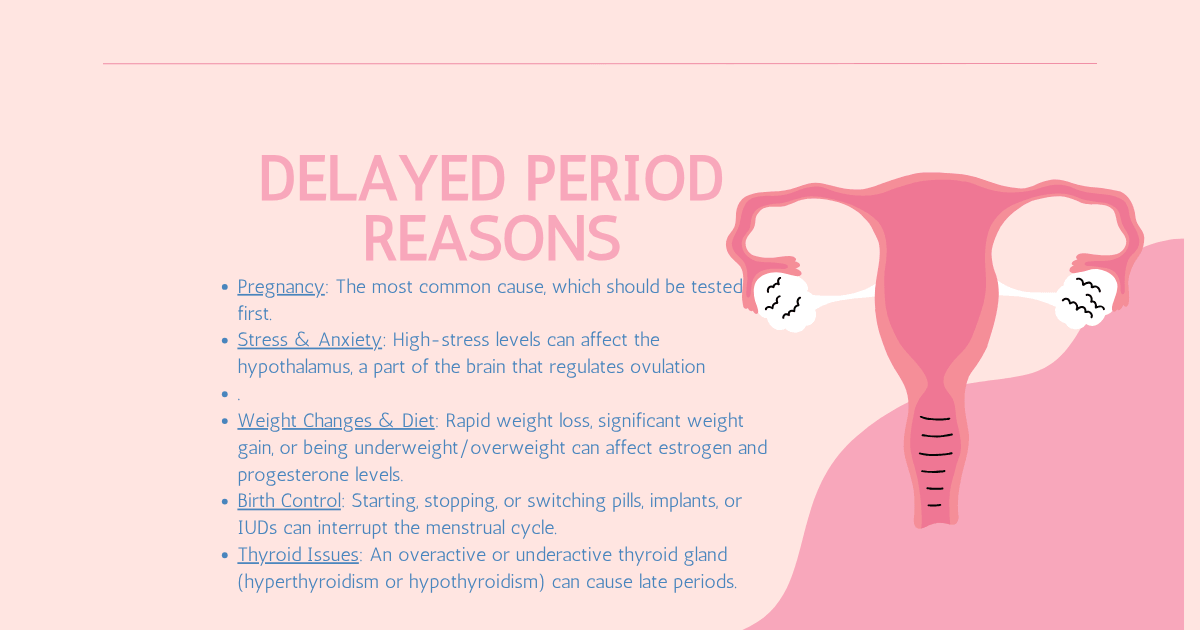
8 Common Reasons Your Period Is 2 Days Late
1. Late Ovulation
This is the most common reason by far. Your period doesn't arrive a fixed number of days after your last period — it arrives a fixed number of days after ovulation (the luteal phase is almost always 12–16 days). If ovulation happened 2 days later than usual — due to anything from a stressful week to a missed sleep night — your period arrives 2 days later. No cause for alarm.
2. Stress
Stress raises cortisol, which directly suppresses the release of GnRH (gonadotropin-releasing hormone). GnRH is the hormone that triggers the chain of events leading to ovulation. When cortisol is elevated — from work pressure, a big life event, or even overexercising — ovulation can be delayed or temporarily disrupted, pushing your period back by a few days.
3. Illness or Infection
Being sick — even with something mild like a cold or flu — can delay ovulation. Your body prioritises fighting illness and may suppress non-essential hormonal processes in the short term. If you were unwell during the first half of your cycle, that's very likely the cause of a short delay.
4. Travel and Disrupted Sleep
Crossing time zones, sleeping at unusual hours, or significant changes to your daily routine can disrupt your circadian rhythm. Melatonin, the sleep hormone, plays a supporting role in hormonal regulation — disrupted sleep patterns can therefore shift the timing of ovulation and your period by several days.
5. Significant Change in Exercise
Starting an intense new workout programme, running a long race, or significantly increasing your training load can delay your period. High-intensity exercise raises cortisol and can temporarily suppress LH (luteinising hormone), the signal for ovulation. Even a single week of unusually intense training can cause a 1–3 day delay.
6. Diet Changes or Undereating
A sudden calorie deficit, a crash diet, or a significant change in eating habits signals to your body that food is scarce. Your body responds by slowing non-essential functions — including ovulation. Even a few days of severe undereating can delay ovulation and therefore your period.
7. Hormonal Contraception Changes
If you recently started, stopped, or switched hormonal contraception — or missed a pill — your cycle can be disrupted. The hormonal shifts involved often cause periods to arrive earlier or later than predicted for 1–3 cycles while your body adjusts.
8. Natural Cycle Variation
Some months your period simply arrives a bit later, with no identifiable cause. This is normal. Even in women with very regular cycles, studies show that cycle length varies by 2–5 days from month to month. Your body is not a metronome — small variations are built in.
When to Take a Pregnancy Test
If you are sexually active and your period is late — even by just 2 days — it is reasonable to take a pregnancy test. Modern pregnancy tests detect the hormone hCG (human chorionic gonadotropin) as early as 10–14 days after conception, which aligns with approximately the day your period is due.
- Test with your first urine of the morning (highest hCG concentration)
- Follow the test instructions exactly — wait the full reading time
- If negative, repeat in 2–3 days if your period still hasn't arrived
- A faint line is still a positive result — hCG rises rapidly in early pregnancy
- Digital tests show "Pregnant / Not Pregnant" and remove line-reading uncertainty
A negative test at 2 days late is reliable but not 100% conclusive — hCG levels in very early pregnancy can sometimes still be below the test's detection threshold. If your period doesn't arrive in the next 3–4 days, test again.
What Symptoms to Watch For
With a period 2 days late, what you're experiencing alongside the delay gives you useful clues:
Symptoms suggesting your period is just coming:
- Bloating, breast tenderness, mild cramps — classic PMS signs that mean bleeding is near
- Irritability or low mood — normal luteal phase changes
- Light spotting or pinkish discharge — often the very start of your period
- A sensation of pressure or heaviness in your lower abdomen
Symptoms worth noting for a pregnancy test:
- Breast tenderness that feels different or more intense than usual PMS
- Nausea, especially in the morning
- Unusual fatigue — sleeping more than normal, feeling exhausted
- Frequent urination
- A heightened sense of smell or food aversions
- Implantation spotting — very light pink or brown spotting, usually shorter and lighter than a normal period
Keep in mind that PMS symptoms and early pregnancy symptoms overlap significantly. The only reliable way to distinguish them at 2 days late is a pregnancy test.
Cramps But No Period — What's Happening?
Cramping without bleeding when your period is due is one of the most common concerns women have. Here's what's usually going on:
Your period is about to start. Uterine contractions (cramps) often begin 12–48 hours before bleeding starts. If you're cramping on day 1 of a 2-day delay, your period may arrive within hours or the next day.
Ovulation pain. If ovulation happened later than usual this cycle, you may have felt mid-cycle cramping (called Mittelschmerz) at a time when you weren't expecting it — and your period is still on its way, just delayed.
Implantation cramping. When a fertilised egg implants into the uterine lining — usually 6–12 days after conception — some women experience mild cramping and light spotting. This can feel similar to period cramps but is typically lighter and shorter-lived.
Digestive cramping. Hormonal changes in the luteal phase affect digestion. Gas, bloating, and intestinal cramps can be mistaken for uterine cramps in the days before a period.
When a 2-Day Delay Is Worth Investigating
In most cases, a period that is 2 days late requires nothing more than waiting a few more days. However, consider seeing a doctor if:
- Your period is 2 days late and this is part of a pattern — cycles are consistently irregular or unpredictable
- You have severe one-sided pelvic pain (can be a sign of ectopic pregnancy — seek care immediately)
- You have heavy bleeding with large clots after a late period (possible early pregnancy loss)
- You've had unprotected sex and multiple negative tests but your period doesn't arrive within 7 days
- You are under significant chronic stress, have lost significant weight, or your cycles have been consistently irregular for 3+ months
How Tracking Removes the Guesswork
The anxiety of a period being 2 days late is almost always made worse when you don't have clear data. If you're not sure when your last period started, if your cycles are typically 27 or 30 days, or whether your cycle has been shifting — every small delay feels bigger than it is.
When you consistently track your cycle, you build a personal baseline. Over 3–6 months, you'll know your typical cycle length, your natural variation, and which months tend to be irregular for you. That knowledge transforms a 2-day delay from anxiety into a data point.
Know Your Cycle — Never Guess Again
Wamiga tracks your period history, predicts your next period based on your personal pattern, and tells you your natural variation range. So when your period is 2 days late, you know immediately whether that's unusual for you — or completely within your normal range.
Frequently Asked Questions
Is a period 2 days late something to worry about?
No. A 2-day delay is within the normal variation range for most menstrual cycles. Doctors only consider a period late after 5+ days. Stress, late ovulation, illness, or travel are the most common explanations for a short delay.
When should I take a pregnancy test if my period is 2 days late?
You can test now — modern tests are sensitive enough to detect pregnancy at the time of a missed period. Use first morning urine for the most accurate result. If negative, test again in 2–3 days if your period still hasn't arrived.
Can stress delay a period by 2 days?
Yes, easily. Stress raises cortisol, which suppresses the hormones that trigger ovulation. A stressful week during the first half of your cycle can delay ovulation — and therefore your period — by 1–5 days.
What if my period is 2 days late and I have cramps but no bleeding?
Cramps without bleeding often mean your period is about to start — cramping typically begins 12–48 hours before bleeding. If cramps are severe or you have one-sided pelvic pain, seek medical attention promptly.
Can being 2 days late be a sign of PCOS?
An isolated 2-day delay is not a sign of PCOS. PCOS causes consistently long or irregular cycles (often 35+ days). A single short delay with no other symptoms is not cause for concern.