You're a full week late and you've taken a pregnancy test — maybe more than one — and they all say negative. Now you're confused, anxious, and searching for answers. What does this combination actually mean?
First, the reassuring news: a period that is a week late with a negative pregnancy test is, in most cases, not a sign of anything serious. It almost always means your period has been delayed by a non-pregnancy cause — and there are several very common ones.
This guide covers exactly what can delay your period by a week, whether you might still be pregnant despite a negative test, and when it's time to see a doctor.
- Can You Trust a Negative Test at 7 Days Late?
- 9 Reasons Your Period Is a Week Late (Not Pregnancy)
- How Stress Pushes Your Period Back by a Week or More
- PCOS and Late Periods
- Thyroid Issues and Your Cycle
- What to Do Right Now
- When to See a Doctor
- Why Your Tracking Data Matters Here
- Frequently Asked Questions
Can You Trust a Negative Test at 7 Days Late?
By the time your period is one week late, a pregnancy test is highly reliable. At this point, if you were pregnant, your hCG (human chorionic gonadotropin) levels would typically be well above the 25 mIU/ml detection threshold of most home tests.
Studies show that a good-quality home pregnancy test is over 99% accurate when used correctly at the time of a missed period — and even more accurate one week after. A negative result at 7 days late is very unlikely to be a false negative.
However, a false negative is still technically possible in rare situations:
- Very diluted urine — testing after drinking a lot of fluids can dilute hCG below detectable levels. Always test with first morning urine.
- Faulty or expired test — a test stored incorrectly or past its expiry date may not work properly.
- Hook effect — an extremely rare situation where hCG levels are so high they saturate the test, causing a false negative. This is uncommon.
- Late implantation — in rare cases, implantation occurs later than usual, delaying the rise of detectable hCG.
If you strongly suspect pregnancy despite a negative test, ask your doctor for a blood test (serum beta-hCG), which can detect pregnancy earlier and with more precision than a home test.
9 Reasons Your Period Is a Week Late (Not Pregnancy)
1. Late or Delayed Ovulation
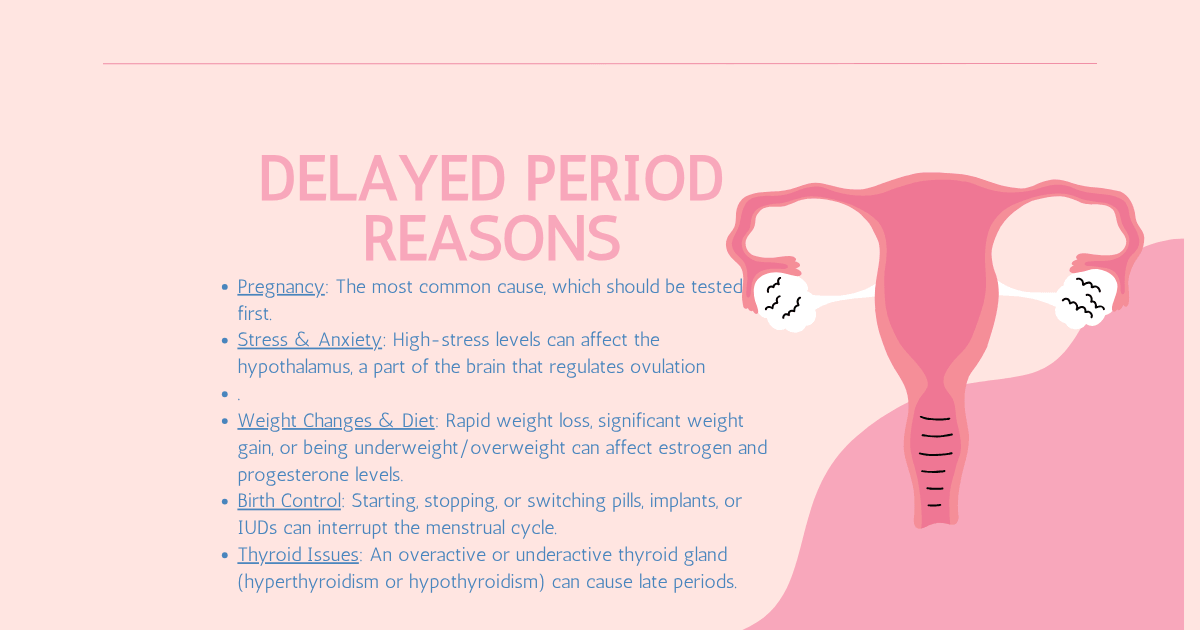
Your period doesn't arrive a fixed number of days after your last period — it arrives roughly 12–16 days after ovulation (the luteal phase). If ovulation was delayed by a week due to any of the factors below, your period will arrive a week later than expected. This is the single most common cause of a late period with a negative pregnancy test.
2. Stress
Stress is the leading lifestyle cause of a delayed period. Elevated cortisol directly suppresses GnRH (the hormone that triggers ovulation). When you're under significant stress during the follicular phase of your cycle, ovulation is delayed — sometimes by many days — and your period follows suit. A stressful work period, exam season, a difficult relationship event, or even accumulated daily stress can push your period back by a full week or more.
3. Significant Weight Change
Rapid weight loss or weight gain disrupts the hormonal signals that regulate ovulation. Fat tissue produces estrogen, so having very low body fat suppresses estrogen production enough to delay or stop ovulation. Conversely, excess body fat raises estrogen levels and disrupts the hormonal balance. Even losing or gaining a small amount of weight very quickly can affect your cycle timing.
4. Intense Exercise or Overtraining
High-intensity training — especially when combined with low calorie intake — sends a signal to your body that resources are scarce. Your body responds by prioritising survival functions and reducing reproductive hormonal signalling. Athletes and women who have recently dramatically increased their training load often experience delayed or missed periods.
5. Illness
Being sick during the first half of your cycle — even something as common as the flu — can delay ovulation. Your immune system takes priority during illness, and the body may suppress non-essential hormonal activity temporarily. A week-late period that follows a recent illness is almost certainly just a delayed cycle.
6. PCOS (Polycystic Ovary Syndrome)
PCOS is one of the most common hormonal conditions in women of reproductive age, affecting up to 10% of women globally. It disrupts the regular follicle development and LH surge needed for consistent ovulation. Women with PCOS often have cycles that are 35–90 days long — or longer — and a week-late period is a very common experience. Other signs include acne, excess body or facial hair, weight gain, and difficulty conceiving.
7. Thyroid Disorders
Both hypothyroidism (underactive thyroid) and hyperthyroidism (overactive thyroid) can significantly disrupt the menstrual cycle. Thyroid hormones are closely linked to the hormones that regulate ovulation. Thyroid disorders are also very common — hypothyroidism alone affects around 5% of women — and are often undiagnosed. If your period is consistently late or irregular and you have symptoms like fatigue, weight changes, hair loss, or feeling cold all the time, ask your doctor to check your thyroid.
8. Starting, Stopping, or Missing Hormonal Contraception
Your cycle takes time to readjust after any change in hormonal birth control. Stopping the pill after years of use can leave cycles irregular for several months. Missing pills can disrupt the hormonal pattern within a cycle. Even switching between methods can cause unpredictable timing for 1–3 cycles.
9. Perimenopause
If you are in your 40s, increasingly irregular periods are a common early sign of perimenopause — the transition phase before menopause. Estrogen production becomes less consistent, ovulation becomes irregular, and periods can arrive significantly later than expected (or not at all). Perimenopause can start as early as the mid-30s for some women, though the mid-40s is more typical.
How Stress Pushes Your Period Back by a Week or More
Stress and the menstrual cycle are deeply connected through the hypothalamic-pituitary-adrenal (HPA) axis. Here's the chain reaction that causes a late period:
- You experience stress → your brain signals the adrenal glands to release cortisol
- High cortisol suppresses the hypothalamus from releasing GnRH (gonadotropin-releasing hormone)
- Without GnRH, the pituitary doesn't release FSH and LH — the hormones needed to mature a follicle and trigger ovulation
- Ovulation is delayed or skipped entirely
- Without ovulation, your period is delayed by the same number of days (or doesn't come at all)
The delay can range from a few days to several weeks depending on how severe and prolonged the stress was, and how sensitive your particular cycle is to hormonal disruption.
Importantly, the stress that causes a late period doesn't have to be dramatic. Consistent low-level chronic stress — busy schedule, poor sleep, worrying — can be enough to shift your cycle by a week.
PCOS and Late Periods
PCOS is worth understanding in detail because it is both very common and frequently underdiagnosed. If your periods are often late — not just occasionally — PCOS is a likely explanation.
In PCOS, the ovaries develop multiple small follicles that don't fully mature or release an egg. Without regular ovulation, the hormonal signals that trigger menstruation don't fire on schedule. The result is cycles that can range from 35 days to several months — with periods eventually arriving when hormone levels shift enough to trigger shedding, or not arriving at all (amenorrhea).
- Your cycles are consistently longer than 35 days, not just occasionally
- You regularly skip periods
- Persistent acne, especially on the chin and jawline
- Excess hair growth on the face, chest, or abdomen
- Difficulty losing weight despite diet and exercise
- Thinning hair on the scalp
PCOS is diagnosed through a combination of blood tests (checking androgens, LH, FSH, insulin) and an ultrasound of the ovaries. It is very manageable with the right treatment and lifestyle changes.
Thyroid Issues and Your Cycle
The thyroid gland produces hormones that regulate metabolism and energy — but they also interact directly with the reproductive hormones that govern your cycle. When thyroid function is off, your periods feel it.
Hypothyroidism (too little thyroid hormone) tends to make periods heavier, longer, and more frequent — but it can also cause irregular cycles and delayed periods. Low thyroid function slows down the metabolism of hormones, disrupting the delicate timing of your cycle.
Hyperthyroidism (too much thyroid hormone) tends to cause lighter, less frequent periods — and can cause them to be irregular or delayed.
A simple TSH (thyroid-stimulating hormone) blood test checks thyroid function. If you haven't had this checked recently and your cycles are consistently irregular, it's one of the first tests a doctor will order.
What to Do Right Now
If your period is a week late and your pregnancy test is negative, here is a practical step-by-step approach:
- Step 1: Retest with first morning urine using a different brand of test, especially if you're not confident in the previous test
- Step 2: Log any recent stress, illness, travel, major exercise changes, or diet shifts in the past 4–6 weeks
- Step 3: Check if you've recently started, stopped, or missed any hormonal contraception
- Step 4: Wait until your period is 2 weeks late before contacting your doctor (unless you have concerning symptoms)
- Step 5: If your period doesn't arrive by 2 weeks late, or if this is a recurring pattern, book an appointment and request a blood test (beta-hCG, thyroid, hormone panel)
When to See a Doctor
Most week-late periods resolve on their own within another few days. However, see a doctor sooner if:
- Your period is more than 2 weeks late with repeated negative tests
- You have severe pelvic pain or one-sided abdominal pain (possible ectopic pregnancy — seek care immediately)
- You have unusual vaginal discharge, fever, or pain during urination alongside the late period
- This is a recurring pattern — your cycles are frequently delayed or irregular
- You have other symptoms alongside the late period: unexplained weight change, extreme fatigue, hair loss, acne flare-ups
- You are trying to conceive and your cycles are unpredictable
Why Your Tracking Data Matters Here
When you see a doctor about a late period, the first thing they will ask is: "Is this normal for you?" If you don't track, you can't answer that confidently. If you do track, you can show them your last 6–12 cycles, your typical cycle length, and your natural variation range.
That data changes everything. It helps your doctor distinguish between a one-off late period (usually nothing) and a pattern of increasingly irregular cycles (worth investigating). It can also help identify whether the delay correlates with a specific life event — like a stressful month or a change in exercise habits.
Track Your Cycle — Know When Something's Off
Wamiga logs every cycle and builds your personal baseline over time. When your period is a week late, you'll know immediately whether that's unusual for you or within your normal range — and you'll have the data your doctor needs to help you faster.
Frequently Asked Questions
Can you be pregnant with a negative test a week after a missed period?
It is very unlikely. By one week after a missed period, hCG levels are high enough for virtually all tests to detect. A false negative is possible with diluted urine or a faulty test, but rare. If in doubt, retest with first morning urine or ask your doctor for a blood test.
What does it mean if my period is a week late and the test is negative?
It most likely means your period has been delayed by a non-pregnancy cause — stress, late ovulation, hormonal imbalance, thyroid issues, or PCOS are the most common explanations. A doctor can identify the cause with blood tests if the pattern continues.
Should I see a doctor if my period is a week late?
If pregnancy tests are negative and you have no concerning symptoms, it's reasonable to wait until your period is 2 weeks late before seeing a doctor. If this happens repeatedly, see a doctor sooner to check for underlying hormonal conditions.
Can stress delay a period by a week?
Yes, easily. Stress raises cortisol, which suppresses the hormones needed for ovulation. Significant or prolonged stress during the first half of your cycle can delay ovulation by a week or more — and your period follows.
Can PCOS cause a period to be a week late with a negative pregnancy test?
Yes. PCOS disrupts regular ovulation, causing periods to be consistently delayed by weeks or even months. Other PCOS signs include acne, excess hair growth, and weight difficulty. A doctor can diagnose it with blood tests and an ultrasound.