~70%
Of women experience breast pain at some point — most often cyclical and hormone-driven
2 in 3
Breast-pain cases are cyclical — tied to the menstrual cycle and usually affecting both breasts
3–5 days
Typical window before your period when tenderness builds, peaks, then eases as bleeding starts
In this article
- Is it normal to have sore breasts before your period?
- Why your breasts hurt — the hormone story
- How long tenderness lasts and when it peaks
- Cyclical vs non-cyclical breast pain
- Sore breasts: period coming or pregnancy?
- How to relieve sore breasts (ranked by evidence)
- When to see a doctor
- Frequently asked questions
Is it normal to have sore breasts before your period?
Yes — in almost every case, breast tenderness before your period is completely normal. Up to 70% of women experience breast pain at some point in their lives, and the cyclical, premenstrual kind is the single most common type in people aged 20–50. The medical name is cyclical mastalgia ("mastalgia" simply means breast pain), and the word cyclical is the reassuring part: it means the pain is tied to your hormonal cycle, predictable, and benign.
It usually shows up as heaviness, swelling, a dull ache, soreness, or a general lumpiness — most often in both breasts, frequently across the upper-outer area. It tends to build in the days before your period and fade once bleeding begins.
Why do your breasts hurt before your period? The hormone story
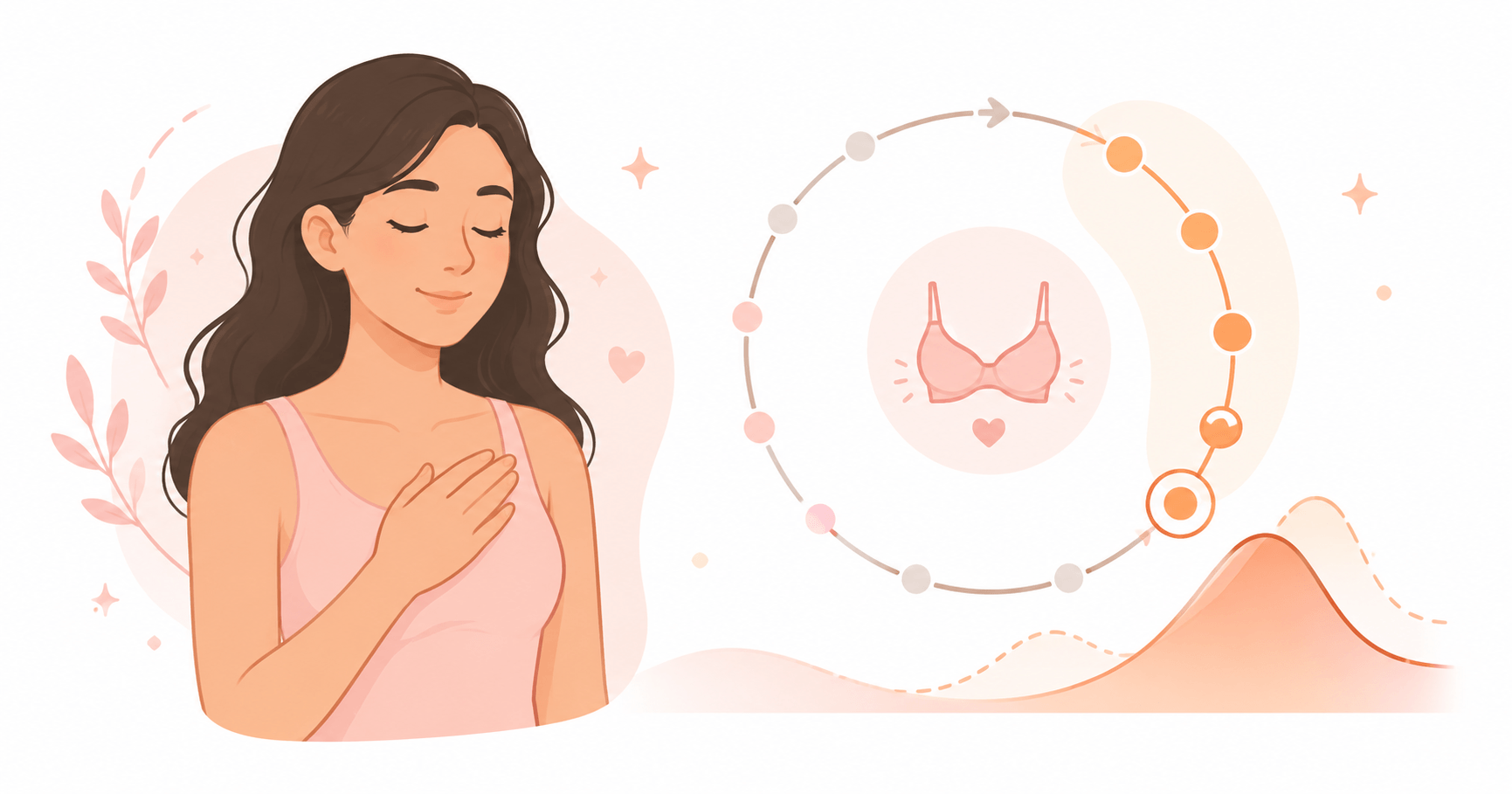
After ovulation, your body enters the luteal phase — the roughly two weeks before your period. During this window, three hormones act on your breast tissue, and together they make your breasts physically swell.
Estrogen
Stimulates the milk ducts, causing them to expand and proliferate. Peaks around ovulation and again influences tissue through the luteal phase.
Progesterone
Enlarges the glandular (lobular) tissue and promotes fluid retention, so the glands swell and the breast holds more water.
Prolactin
Stimulates the ducts further. Combined with the above, this drives swelling, stretching and sensitivity of breast tissue and nerves.
The net effect is lobule enlargement, cell proliferation and stromal swelling (edema). Your breasts genuinely get bigger and heavier, stretching the surrounding tissue and nerves — which is what you feel as soreness and tenderness. Once your period starts and estrogen and progesterone drop, the swelling subsides and the pain eases.
How long does breast tenderness last before a period?
Cyclical breast tenderness is predictable — that's what makes it manageable. It typically begins 3–5 days before your period (sometimes up to two weeks), peaks just before bleeding, and resolves within the first day or two of your period.
When Breast Tenderness Peaks Across a 28-Day Cycle
Period
Day 1–5
Easing
Day 1–5
Easing
Follicular — Comfortable
Day 6–13
Day 6–13
Ov.
mild
mild
Early Luteal
Day 15–22
Building
Day 15–22
Building
Late Luteal — PEAK
Day 23–28
Day 23–28
Breast tenderness level
Comfortable (follicular)
Mild ovulation tenderness
Peak tenderness (late luteal)
Some women also feel a brief, milder tenderness around ovulation when estrogen surges mid-cycle.
Because the timing is so consistent, tracking it turns a recurring worry into a known pattern. If you can see that tenderness reliably starts on day 24 and fades on day 2, you can plan supportive measures ahead — and you'll immediately notice if something ever changes.
Cyclical vs non-cyclical breast pain — which do you have?
Not all breast pain is hormonal. Telling the two types apart helps you know whether it's a normal cycle symptom or worth getting checked.
Cyclical (hormonal)
Linked to cycleYes — pre-period
LocationUsually both breasts
PatternDiffuse, upper-outer
Typical age20s–30s
ResolvesWhen period starts
Non-cyclical
Linked to cycleNo
LocationOften one breast / spot
PatternConstant or random
Typical age30s–40s
CausesMuscle, chest wall, etc.
Cyclical pain that affects both breasts and tracks with your period is reassuringly typical. Pain that's fixed to one spot in one breast, constant, and unrelated to your cycle is the kind worth mentioning to a doctor — not because it's usually serious, but because it deserves a proper look.
Sore breasts: period coming or pregnancy?
This is one of the most anxious questions — and an honest answer matters: the symptoms overlap heavily, so you often can't tell from the tenderness alone. That said, a few clues lean one way or the other.
PMS tenderness
Timing~3–5 days before period
Over timeEases when period starts
IntensityMild–moderate, familiar
Areola/veinsNo change
Early-pregnancy tenderness
Timing~1–2 weeks after conception
Over timePersists or worsens
IntensityOften fuller, very sensitive
Areola/veinsDarkening, more visible veins
The honest bottom line: these clues are suggestive, not reliable. The only definitive way to know is a missed period followed by a pregnancy test. If your period is late and breast tenderness is sticking around, take a test.
How to relieve sore breasts before your period
Here are the relief options ranked by how strong the evidence behind them is — so you can start with what actually works.
👚 A properly fitted supportive / sports bra Strong
The cheapest, safest, best-evidenced first step — improves pain in up to 85% of women, especially those with larger breasts. A firm, well-fitted bra (including a soft one worn at night) reduces tissue movement and the stretching that causes pain. Get measured; many women wear the wrong size.
💊 NSAIDs — especially topical (diclofenac gel) Strong
Anti-inflammatory pain relief helps up to ~80% of people. Topical NSAIDs applied to the area are effective and avoid the stomach side effects of tablets. Oral ibuprofen also works. Use as directed and check with a pharmacist if you have any contraindications.
🌿 Magnesium (luteal phase) Moderate
ACOG notes magnesium may reduce water retention, bloating and breast tenderness when taken in the luteal phase. Low-risk to trial; the glycinate form is gentle on the stomach.
🥛 Calcium (~1,200 mg/day) & lifestyle Moderate
Calcium reduces physical PMS symptoms overall. Pair with the lifestyle basics ACOG supports: regular aerobic exercise, reducing dietary salt and fat, and warm or cold compresses on sore areas.
☕ Cutting back caffeine & salt Mixed — worth a trial
The evidence for caffeine is inconsistent and no firm causal link is proven — but many women report less tenderness when they cut back, and reducing salt eases fluid retention. Low-cost to test on yourself for a cycle or two.
🌼 Evening primrose oil Popular but unproven
Honest take: a meta-analysis of 13 randomised trials (1,752 patients) found no benefit over placebo for breast pain. It's safe with few side effects, so trying it does little harm — just keep your expectations realistic and don't rely on it over the proven options above.
Myth-buster: Evening primrose oil is recommended all over the internet for breast pain, but the best evidence says it works no better than a placebo. A well-fitted supportive bra and anti-inflammatory pain relief are far more reliable.
Logging breast tenderness each day in Wamiga — even a quick 1–5 rating — reveals your personal pattern in 2–3 cycles, so you can predict the sore days and prepare. It also makes any unusual change easy to spot. Download Wamiga free →
When to see a doctor about breast pain
Reassuring fact first: breast pain is rarely a sign of cancer — fewer than 10% of breast cancer cases involve pain at all. Still, see a doctor if you notice any of these:
A new lump that doesn't go away after your period
Cyclical lumpiness that comes and goes with your cycle is normal. A distinct lump or mass that persists after bleeding ends should be checked.
Pain fixed to one spot in one breast
Especially if it's constant, unrelated to your cycle, and doesn't settle within a few weeks.
Nipple discharge or a newly inverted nipple
Particularly bloody or clear discharge from one side, or a nipple that has newly turned inward.
Skin changes or a change in size/shape
Dimpling, puckering, redness, an "orange-peel" texture, or a noticeable change in breast size or shape. Redness with warmth and fever can signal an infection (mastitis) needing prompt care.
Frequently asked questions
How many days before your period do your breasts get sore?
Usually about 3 to 5 days before your period, during the late luteal phase, though some notice it up to two weeks ahead. It peaks just before bleeding and eases within the first day or two of your period as hormone levels fall. Some women also feel mild tenderness around ovulation.
Why do my breasts hurt before my period?
Rising luteal-phase hormones change your breast tissue: estrogen stimulates the milk ducts, progesterone enlarges the glandular tissue and causes fluid retention, and prolactin adds to the effect. Your breasts swell and stretch surrounding tissue and nerves, producing the soreness, heaviness and lumpiness of cyclical mastalgia — normally in both breasts.
Is breast tenderness a sign of period or pregnancy?
It can be either, because the symptoms overlap. PMS tenderness usually eases when your period starts, while pregnancy tenderness tends to persist or worsen and may come with darkening areolas and more visible veins. These clues aren't reliable on their own — the only definitive answer is a missed period followed by a pregnancy test.
How can I relieve sore breasts before my period?
Start with the best-evidenced steps: a properly fitted supportive or sports bra (helps up to 85% of women) and anti-inflammatory pain relief, especially topical NSAIDs. Worth trying: magnesium and calcium in the luteal phase, less salt and caffeine, regular exercise, and warm or cold compresses. Tracking your cycle helps you anticipate and prepare for the sore days.
Does evening primrose oil work for breast pain?
Probably not. Despite its popularity, a meta-analysis of 13 randomised trials involving 1,752 patients found no benefit over placebo for cyclical breast pain. It's safe with few side effects, but the better-supported options are a supportive bra and anti-inflammatory pain relief.
When should I see a doctor about breast pain?
Breast pain alone is rarely cancer (under 10% of cases involve pain), but see a doctor for a new lump that persists after your period, pain fixed to one spot in one breast, nipple discharge or a newly inverted nipple, skin dimpling, puckering or redness, a change in breast size or shape, or pain that doesn't settle within a few weeks. Redness with warmth and fever may mean an infection needing prompt care.
This article is for general information only and isn't a substitute for medical advice. If you're worried about a symptom, please speak to a qualified healthcare professional.