
How to Make Your Period Come Faster: 8 Methods Explained
Only one method is medically proven. An honest breakdown with evidence ratings for each approach.
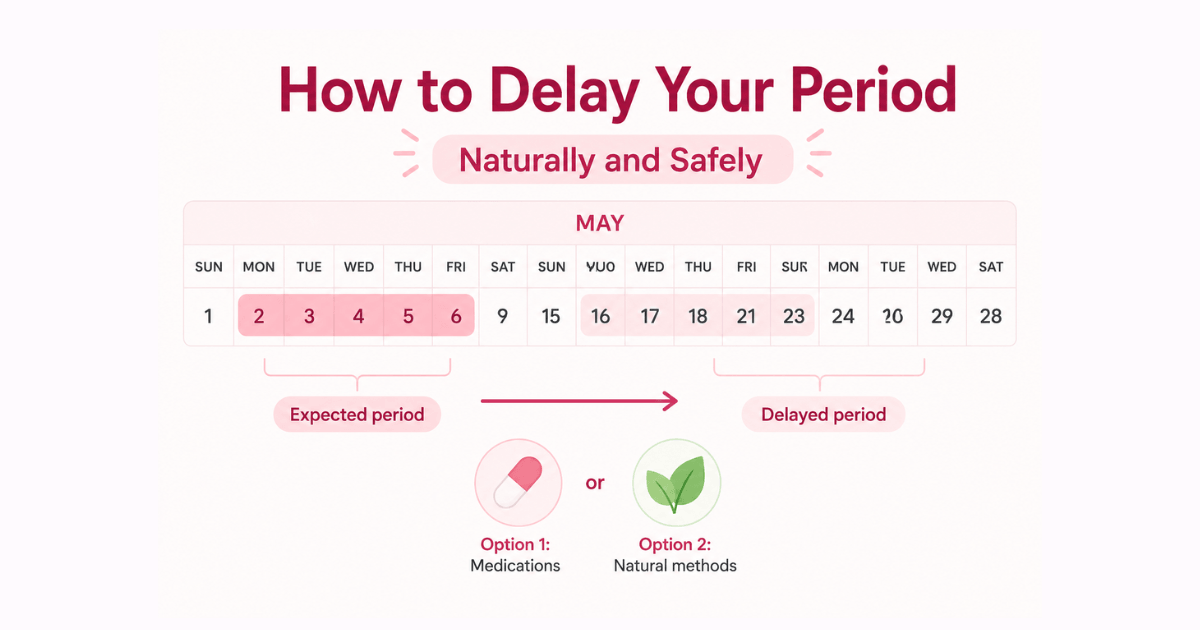
A holiday, a wedding, an important race, or simply not wanting to deal with it right now. There are plenty of reasons someone might want to push their period back a week. The good news: it's possible. The important news: only two methods are genuinely reliable — and several popular "natural" approaches have no evidence behind them at all.
This guide gives you the honest breakdown of every method, its evidence rating, how far in advance you need to plan, and who should avoid each one.
Two methods are medically proven to delay a period: (1) Norethisterone — a prescription progestogen tablet taken 3 days before your expected period, and (2) Pill-stacking — skipping the pill-free interval if you are already on the combined contraceptive pill. Ibuprofen in high doses may help reduce flow and delay by 1–2 days. All other "natural" methods lack clinical evidence.
| Method | Evidence | Max delay | Notice needed | Availability |
|---|---|---|---|---|
| Norethisterone | ★★★★★ | Up to 17 days | Start 3 days before | Prescription |
| Pill-stacking (combined pill) | ★★★★★ | Indefinite (with guidance) | Plan at start of pack | Prescription |
| Ibuprofen (high dose) | ★★★★★ | 1–3 days (inconsistent) | Day of period | Over the counter |
| Lemon juice / ACV | ★★★★★ | Not proven | — | No evidence |
| Gelatin / herbal methods | ★★★★★ | Not proven | — | No evidence |
Norethisterone is a synthetic progestogen — a man-made version of progesterone, the hormone that naturally prevents your uterine lining from shedding during the second half of your cycle. Taking it artificially maintains high progestogen levels, which tells the body it is still in the post-ovulation (luteal) phase. The lining does not shed as long as the tablets are continued.
How to take it: The standard dose is 5mg three times daily (so three tablets per day, evenly spaced). You must start it 3 days before your expected period — it will not stop a period that has already begun. It can be taken for a maximum of 17 days, giving a potential delay of up to 14 days. Your period will usually arrive 2–3 days after you stop taking it.
Important: Norethisterone at this dose is not a contraceptive. If you are not on another form of contraception, you still need to use barrier contraception (e.g., condoms) while taking it.
Common side effects include bloating, breast tenderness, nausea, headaches, mood changes, and reduced libido. Some women also experience breakthrough spotting. These resolve once the medication is stopped.
If you take a combined oral contraceptive pill (one that contains both oestrogen and progestogen — such as Microgynon, Rigevidon, Yasmin, or Cilest), you can delay your withdrawal bleed by simply skipping the hormone-free interval or the inactive (placebo) pill week at the end of the pack.
How to do it: When you finish the active pills in one pack, start the active pills of the next pack immediately the following day — without taking the 7-day break or the placebo pills. Your body will not experience the drop in hormone levels that triggers the withdrawal bleed, so no bleed occurs during that time.
This is safe for most combined pill users and is widely endorsed by gynaecologists and sexual health bodies including the Faculty of Sexual and Reproductive Healthcare (FSRH). It does not reduce the pill's contraceptive effectiveness.
Some women experience breakthrough spotting when running two packs together, particularly in the third or fourth week of the extended pack — this is common and not a sign that something is wrong.
Ibuprofen is an NSAID (non-steroidal anti-inflammatory drug) that works by inhibiting prostaglandins — the compounds that trigger uterine contractions and increase blood flow during a period. At standard doses it reduces cramping and flow. At higher doses (800mg three times daily), some studies suggest it can reduce menstrual blood loss by up to 35% and may delay the onset of a period by 1–3 days in some women.
However, results are inconsistent. Ibuprofen is not designed to delay periods and will not work reliably for everyone. It is more useful as a flow-reducer or cramp-reliever than as a period-delaying strategy.
A number of natural methods circulate online as ways to delay a period. Here is the evidence-based verdict on each. None have been validated in clinical trials as reliable period-delaying methods.
No clinical evidence it delays periods. Highly acidic (pH 2–3), it can damage tooth enamel if consumed in large amounts. The acidity may temporarily affect vaginal pH but does not suppress menstruation.
No scientific evidence it delays or stops periods. Claims are anecdotal only. Like lemon juice, it may cause tooth enamel erosion and digestive irritation in large quantities.
Based on the idea that gelatin "thickens" the uterine lining and slows flow. No biochemical basis for this. No controlled studies exist. Not recommended.
Intense exercise can delay ovulation if done early in the cycle, but if your period is already due, it will not stop it. In fact, very intense exercise can worsen cramping during flow.
Shepherd's purse, yarrow, and similar herbs are sometimes cited. Evidence is anecdotal and some carry potential liver toxicity at high doses. They do not reliably delay periods.
A widespread myth with no physiological basis. Food temperature does not affect hormone levels or uterine lining shedding. This will not delay your period.
Delaying a period using hormonal methods is safe for most healthy women, but not for everyone. Seek medical advice before using norethisterone or pill-stacking if you have any of the following:
If you are unsure whether you are suitable, your GP, gynaecologist, or a pharmacist can advise within a short consultation. Many online prescription services now offer same-day norethisterone prescriptions, so planning one week ahead is usually sufficient.
Know your cycle before you delay it
Wamiga predicts your next period date so you know exactly when to start norethisterone — or when to plan around it.
Only one method is medically proven. An honest breakdown with evidence ratings for each approach.

Evidence-ranked remedies from ibuprofen timing to magnesium, heat, and ginger.
The 7 most common causes of irregular cycles and a clear guide on when to act.
The guidance in this article is informed by reputable medical and public-health organizations: