
Missed Period but Not Pregnant: 9 Reasons Why
Negative test, still no period. Here are 9 real causes — and what to do about each one.
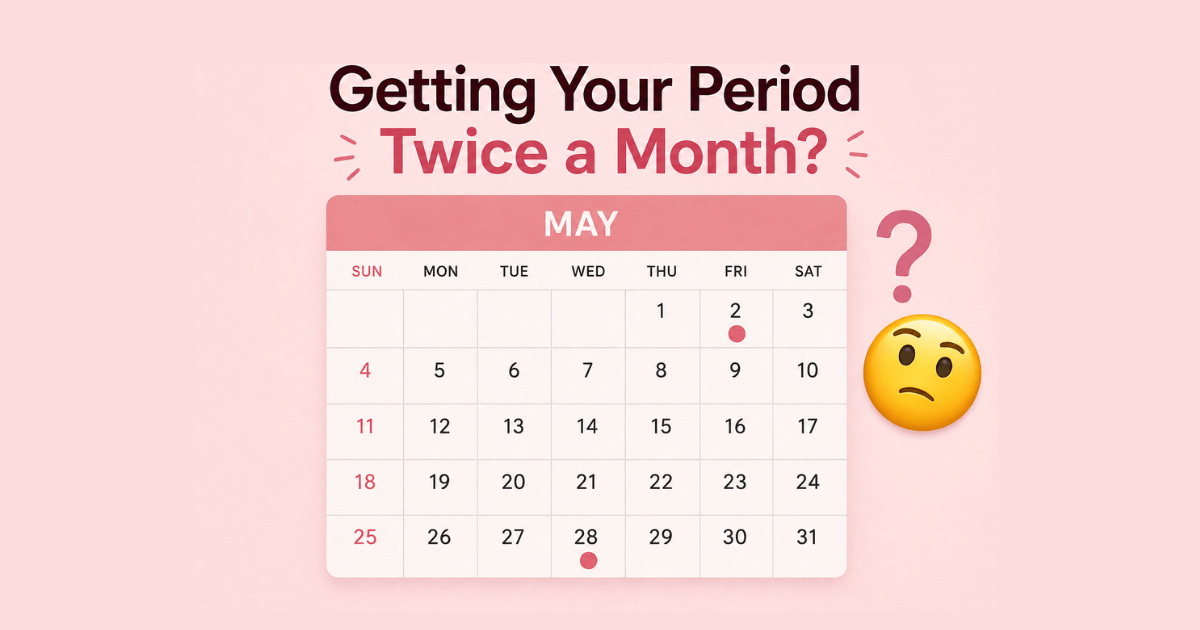
Your cycle skipped a month. Or it showed up twice. Or it arrived on time but lasted two days when it usually lasts five. You're not imagining it — and you're not alone. Irregular periods affect roughly 1 in 5 women at some point in their reproductive years.
Most of the time, an occasional off-cycle is nothing to worry about. But when irregularity becomes a pattern, it's usually your body flagging something that deserves attention — and most causes are very treatable once you know what's going on.
An irregular period is one where your cycle length varies by more than 9 days between your shortest and longest cycle over a 3-month window, or where cycles regularly fall outside the 21–35 day normal range. A single late or early period is almost always normal.
Doctors use specific terms for different patterns of menstrual irregularity. Knowing the terminology helps you describe what you're experiencing accurately when you see a doctor.
| Term | What it means | Cycle length / pattern |
|---|---|---|
| Oligomenorrhea | Infrequent periods | Cycles longer than 35 days |
| Polymenorrhea | Very frequent periods | Cycles shorter than 21 days |
| Amenorrhea | No period at all | Absent for 3+ months (secondary) or never started by age 15 (primary) |
| Metrorrhagia | Bleeding between periods | Spotting or bleeding outside expected window |
| Variable cycles | Unpredictable timing | Shortest and longest cycles differ by >9 days |
In most cases, irregular cycles trace back to one of seven causes. These aren't ranked by severity — they're ranked by how commonly each one shows up in women of reproductive age.
Elevated cortisol suppresses GnRH in the hypothalamus, which delays or skips the LH surge needed for ovulation. A single high-stress month can push your cycle 5–10 days late. Chronic stress leads to persistent irregularity.
Polycystic ovary syndrome is the most common hormonal disorder in women of reproductive age. Elevated LH and androgens prevent follicles from completing ovulation, causing cycles that can be 40–90+ days long — or absent entirely.
Both hypothyroidism and hyperthyroidism disrupt menstrual cycles. An underactive thyroid slows metabolism and can increase prolactin, while an overactive thyroid can cause very light, infrequent periods. TSH is a simple blood test to rule this out.
Body fat produces leptin, which signals the hypothalamus to maintain reproductive function. Drop below roughly 22% body fat and leptin falls — the hypothalamus dials back GnRH and ovulation stops. Rapid weight gain (as in insulin resistance) also disrupts cycles.
The average onset is age 47, though it can begin in the early 40s. As ovarian reserve declines, estrogen levels fluctuate and FSH rises — cycles become shorter, then longer, then skip entirely before menopause. This is entirely normal in the right age context.
Prolactin (produced by the pituitary) is naturally high during breastfeeding, which suppresses ovulation on purpose. But elevated prolactin outside of breastfeeding — from a small pituitary adenoma, certain medications, or hypothyroidism — causes the same cycle disruption.
Irregular cycles are expected and normal in two specific life phases: the first 2–3 years after your first period (the hypothalamic-pituitary axis is still calibrating), and the transition into menopause. No treatment needed in either case — just tracking helps.
Irregular timing alone isn't always a red flag. But certain symptoms alongside irregular cycles point strongly toward specific causes and are worth noting before your doctor visit:
Not every irregular cycle needs medical attention. Here's a clear split:
A standard workup for irregular periods typically includes a blood panel run on specific cycle days:
Tracking an unpredictable cycle is more valuable than tracking a regular one — patterns that look random often reveal themselves over 3–6 months of data. Three things to log daily:
Wamiga tracks all three automatically. The app plots your cycle history, flags irregular patterns, and generates a health summary you can bring to your doctor appointment — which saves a lot of back-and-forth on dates.
Track your cycle with Wamiga
Spot irregular patterns early. Get a health report you can share with your doctor.
Negative test, still no period. Here are 9 real causes — and what to do about each one.
Stress, PCOS, thyroid issues, and 7 other science-backed reasons your period might be late.

21–35 days is normal — not always 28. Learn what's actually average, and what changes it.
The guidance in this article is informed by reputable medical and public-health organizations: