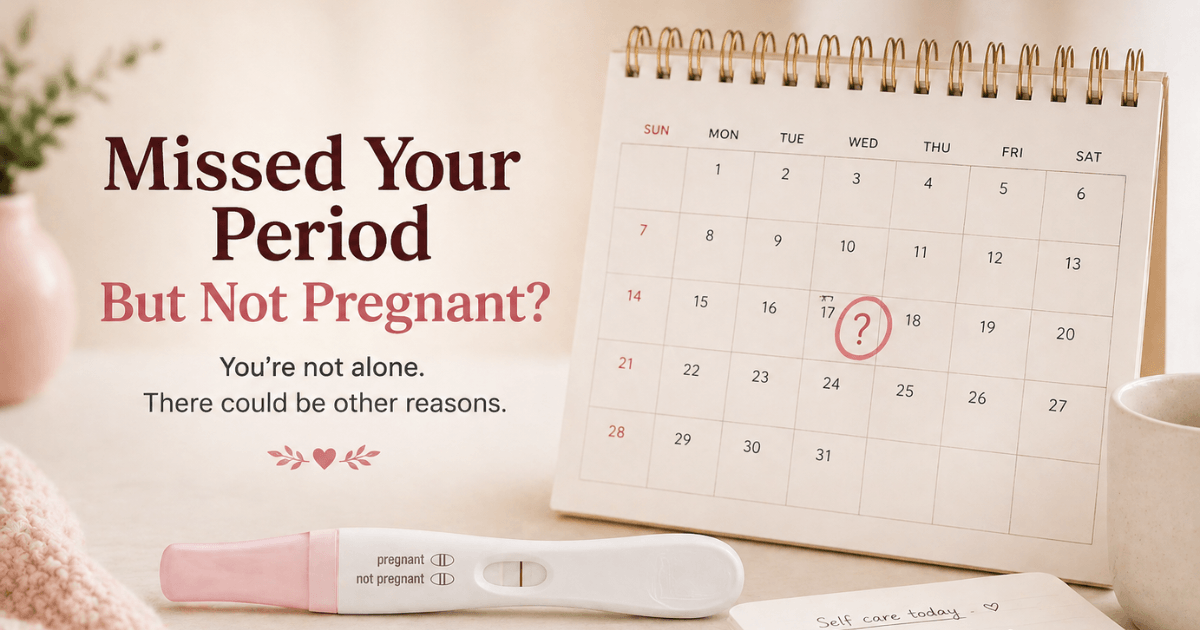
You took the test. It's negative. But your period still hasn't come — and now you're in that anxious in-between space, wondering what your body is doing. A missed period without pregnancy is very common, and in most cases, it has a clear and treatable cause. Your period going missing means one thing: ovulation either didn't happen that cycle, or happened so late that the period simply hasn't arrived yet.
Here are the 9 most common reasons — explained honestly, with what to do about each one. Bookmark this. The answer to what's going on with your body is almost certainly in here.
- First: Confirm the Test Is Reliable
- 1. Stress
- 2. PCOS
- 3. Thyroid Dysfunction
- 4. Hypothalamic Amenorrhoea (Exercise + Low Weight)
- 5. Significant Weight Change
- 6. High Prolactin
- 7. Perimenopause
- 8. Post-Pill Amenorrhoea
- 9. Illness or Medication
- What Blood Tests to Ask For
- When to See a Doctor
- Frequently Asked Questions
First: Confirm the Test Is Reliable
Before diving into causes, one important check: a home pregnancy test is very reliable when taken correctly — but two conditions can give a false negative:
- Testing too early: hCG (the pregnancy hormone) may not yet be high enough to detect. If you tested within a day or two of a missed period, test again 5–7 days later with first-morning urine.
- Diluted urine: Testing mid-afternoon after drinking a lot of fluids can dilute hCG below the test's detection threshold. First-morning urine gives the most concentrated and reliable result.
A reliable negative test taken with first-morning urine 7+ days after a missed period makes pregnancy extremely unlikely — well under 1%. You can confidently move on to the other causes below.
1 Stress
This is the most common reason a healthy woman misses a period — and it is completely real, not just "in your head." When you are under significant psychological or physical stress, your adrenal glands flood the body with cortisol. Cortisol directly suppresses GnRH — the gonadotropin-releasing hormone produced by the hypothalamus that kicks off the entire hormonal cascade leading to ovulation.
No GnRH pulse → no FSH → no follicle development → no ovulation → no progesterone drop → no period. The whole chain stalls. This is your body's ancient survival mechanism: reproduction is deprioritised when the brain perceives danger or scarcity.
The stressor doesn't have to be dramatic. A heavy exam period, a job loss, a relationship breakdown, a bereavement, a major illness, or even a holiday that disrupts your sleep and routine can be enough to delay or skip ovulation entirely.
2 PCOS (Polycystic Ovary Syndrome)
PCOS is the most common hormonal disorder in women of reproductive age — affecting up to 10% of women worldwide — and irregular or absent periods are its most defining feature. In PCOS, elevated androgens (male hormones) and disrupted LH-to-FSH ratios interfere with follicle development. Follicles begin maturing but stall before releasing an egg. No egg = no ovulation = no period.
Some women with PCOS go months without a period, then have a very heavy bleed when the lining finally sheds. Others have infrequent periods (oligomenorrhoea) of 35–90 day cycles. The condition exists on a spectrum — some women have mild irregularity; others have very few periods a year.
PCOS is frequently accompanied by: acne (particularly on the jaw and chin), excess facial or body hair (hirsutism), difficulty losing weight or unexplained weight gain, oily skin, and scalp hair thinning. You do not need all of these to have PCOS — irregular periods alone can be sufficient for a diagnosis alongside the right blood work and ultrasound findings.
3 Thyroid Dysfunction
Your thyroid sits quietly in your neck and regulates nearly every metabolic process in your body — including your menstrual cycle. Both an underactive thyroid (hypothyroidism) and an overactive thyroid (hyperthyroidism) can disrupt ovulation and cause missed periods, though through different mechanisms.
Hypothyroidism slows metabolism and raises TRH (thyrotropin-releasing hormone), which in turn raises prolactin — a hormone that suppresses GnRH and ovulation. It is also associated with elevated oestrogen relative to progesterone, disrupting the hormonal cycle. Hyperthyroidism accelerates everything, including oestrogen metabolism, which can cause the cycle to become erratic or stop entirely.
Thyroid dysfunction is significantly underdiagnosed — particularly subclinical hypothyroidism, where TSH is elevated but not dramatically so, and symptoms are vague. Clues: fatigue that sleep doesn't fix, unexpected weight changes, feeling unusually cold or hot, hair loss, brain fog, constipation or loose stools, and mood changes.
4 Hypothalamic Amenorrhoea
Hypothalamic amenorrhoea (HA) is what happens when the hypothalamus — the brain region that controls reproductive hormones — essentially goes quiet. It is almost always caused by a combination of excessive exercise, insufficient caloric intake, low body weight, and high psychological stress — often two or more of these at once.
The hypothalamus reads energy availability. When caloric intake is consistently lower than energy expenditure (regardless of absolute weight), it interprets this as an unsurvivable environment for pregnancy and suppresses GnRH. Periods stop — sometimes for months or years. This is common in endurance athletes, dancers, gymnasts, and women who have significantly restricted their diet.
HA is different from PCOS in important ways: FSH and LH are both low (not the skewed LH:FSH ratio of PCOS), oestrogen is very low, and there is no elevated androgen. It is also different from anorexia — you don't have to have an eating disorder to develop HA. High athletic training volume alone can cause it, especially when combined with any degree of under-fuelling.
5 Significant Weight Change
Both significant weight loss and rapid weight gain can disrupt menstrual cycles — through different pathways.
Weight loss / low body fat: Adipose (fat) tissue is an active oestrogen-producing organ. When body fat drops below around 17–20% (the threshold varies between individuals), oestrogen production falls, GnRH output is suppressed, and periods become irregular or absent. This is why athletes and women who have lost weight rapidly often experience cycle disruption even if they still consider themselves a "normal" weight.
Weight gain / obesity: Excess body fat leads to higher circulating oestrogen (from aromatisation in fat cells) without the counterbalancing progesterone that comes from ovulation. This oestrogen dominance, combined with insulin resistance often associated with weight gain, disrupts the LH surge needed for ovulation. Cycles become irregular, and periods may be skipped.
6 High Prolactin (Hyperprolactinaemia)
Prolactin is the hormone that drives milk production after childbirth. When prolactin is elevated outside of breastfeeding — a condition called hyperprolactinaemia — it powerfully suppresses GnRH and ovulation, causing missed or absent periods.
The most common causes of elevated prolactin include:
- Prolactinoma: A benign (non-cancerous) pituitary tumour that produces excess prolactin. The most common pituitary tumour — affects around 1 in 1,000 people. Usually small (microadenoma) and very manageable.
- Medications: Many common drugs raise prolactin — including antipsychotics, some antidepressants (SSRIs, tricyclics), metoclopramide (anti-nausea), and some blood pressure medications.
- Hypothyroidism: Elevated TRH from an underactive thyroid stimulates prolactin production as a secondary effect.
A clue: elevated prolactin sometimes causes galactorrhoea — unexpected milky nipple discharge unrelated to breastfeeding. Not everyone gets this symptom, but if you do alongside missed periods, it strongly points toward prolactin as the cause.
7 Perimenopause
Perimenopause — the transition phase before menopause — typically begins in the mid-40s, but can start in the late 30s for some women. As ovarian reserve declines, oestrogen and progesterone levels fluctuate unpredictably. Some cycles are anovulatory (no ovulation occurs), meaning no period follows. Cycles that do occur may be heavier, lighter, shorter, or longer than your previous normal.
Missing the occasional period — or having a 60-day gap instead of your usual 28 — is often the first concrete sign that perimenopause has begun. It is frequently accompanied by other symptoms: hot flushes, night sweats, sleep disruption, mood changes, vaginal dryness, or a sense that your body is simply "different" to how it used to feel.
Perimenopause does not mean you cannot get pregnant — ovulation can still occur unpredictably. Contraception remains important until 12 consecutive months with no period have passed (the definition of menopause).
8 Post-Pill Amenorrhoea
Stopping the combined oral contraceptive pill (or other hormonal methods) does not always result in an immediate return to normal periods. For some women, the hypothalamic-pituitary-ovarian axis takes weeks to months to fully restart after suppression by synthetic hormones.
Post-pill amenorrhoea — the absence of a period for 3+ months after stopping the pill — affects roughly 3% of women. More commonly, cycles simply take 1–3 months to regulate, especially if your periods were irregular before starting the pill (the pill masks but does not treat underlying conditions like PCOS).
An important point: stopping the pill does not reveal a new problem — it reveals what was always there. If periods are absent for more than 3 months post-pill, the investigation should focus on the underlying hormonal picture, not the pill itself.
9 Acute Illness or Medication
A significant acute illness — a serious infection, a high fever, major surgery, or a severe inflammatory episode — can temporarily suppress the HPG (hypothalamic-pituitary-gonadal) axis through the cortisol stress response. This is the same mechanism as psychological stress, but triggered by physical illness. The period of that cycle may be delayed or skipped entirely, with normal cycles resuming the following month.
Several medications beyond hormonal contraception can also disrupt menstrual cycles:
- Antipsychotics and some antidepressants — via prolactin elevation
- Chemotherapy — can cause temporary or permanent amenorrhoea depending on the agent and dose
- Corticosteroids (long-term use) — suppress GnRH via a similar mechanism to cortisol
- Opioids — suppress the HPG axis directly
- Some epilepsy medications — affect sex hormone-binding globulin levels
What Blood Tests to Ask For
If you have missed 2+ periods and pregnancy is ruled out, ask your GP for this standard panel. It covers the vast majority of causes in a single appointment:
- FSH and LH — Assesses ovarian function; identifies PCOS (elevated LH relative to FSH) or premature ovarian insufficiency (elevated FSH)
- Estradiol (oestrogen) — Low in hypothalamic amenorrhoea and premature menopause
- Progesterone — Taken day 21 of a 28-day cycle (or 7 days before expected period) to confirm whether ovulation occurred
- Prolactin — Rules out hyperprolactinaemia; should be taken in the morning, fasting, without recent stress or exercise
- TSH — Screens for thyroid dysfunction
- Testosterone and DHEAS — Screens for PCOS and adrenal androgen excess
- AMH (Anti-Müllerian Hormone) — Optional but useful for assessing ovarian reserve, especially if perimenopause is suspected before 45
Track Every Cycle — Know Your Pattern
When your period goes missing, knowing your exact cycle history — how long your last 6 cycles were, when ovulation usually happens, what changed — makes a doctor's appointment far more productive. Wamiga logs it all automatically. Free on iOS and Android.
When to See a Doctor
- You have missed 3 or more consecutive periods (amenorrhoea) and pregnancy is ruled out
- You have missed 2 periods and have symptoms pointing to PCOS, thyroid dysfunction, or prolactin excess
- Your periods stopped after stopping the pill and haven't returned in 3 months
- You have unexplained nipple discharge alongside missed periods
- You are trying to conceive — missed or irregular periods need to be addressed for successful conception
- A single missed period with no identifiable cause — if you feel something is off, trust that instinct and get checked
The most important message: a missed period without pregnancy is a signal, not a mystery. The 9 causes above cover the overwhelming majority of cases — and every single one of them is identifiable with a blood test and, where needed, an ultrasound. Most are very treatable. You do not have to just wait and hope your cycle sorts itself out.
Frequently Asked Questions
Can you miss a period and not be pregnant?
Yes — very commonly. The most frequent causes are stress (which suppresses the hormonal chain that triggers ovulation), PCOS, thyroid dysfunction, significant weight changes, over-exercising, elevated prolactin, perimenopause, or the aftermath of stopping hormonal contraception. A reliable pregnancy test taken 7+ days after a missed period that reads negative makes pregnancy very unlikely.
How long can stress delay a period?
Stress can delay a period by days to several weeks — and in severe or prolonged cases, can suppress periods entirely for months. High cortisol directly inhibits GnRH, the master signal that drives ovulation. Once the stressor resolves, the hypothalamic-pituitary axis typically restores normal function within 1–3 cycles, though this varies between individuals.
What blood tests should I get for a missed period?
If pregnancy is ruled out and you've missed 2+ periods, ask for: FSH, LH, estradiol, progesterone (day 21), prolactin, TSH, testosterone, and DHEAS. This panel covers the majority of causes — PCOS, thyroid dysfunction, hyperprolactinaemia, hypothalamic amenorrhoea, and perimenopause — in a single appointment. AMH can also be useful for assessing ovarian reserve.
Can losing weight cause a missed period?
Yes — significant or rapid weight loss is a common cause. When body fat drops below a critical threshold, oestrogen production falls and the hypothalamus suppresses GnRH to deprioritise reproduction in a perceived energy-scarce environment. This is called hypothalamic amenorrhoea. Increasing caloric intake toward maintenance typically restores periods within 2–3 months, though it can take longer.
When should I see a doctor for a missed period?
See a doctor after missing 3 or more consecutive periods with pregnancy ruled out — or after 2 missed periods if you have symptoms suggesting PCOS, thyroid issues, or prolactin excess. A single missed period with an obvious identifiable cause can be observed for one more cycle. Persistent missed periods should always be investigated — the cause is almost always findable and treatable.