Your period blood is not just red. On any given cycle it can shift from pink to bright red to dark brown to near-black — sometimes all in the same week. Most of those colour changes are completely normal and simply reflect how fast the blood is moving and how long it has been sitting in the uterus. But two colours in particular are genuine red flags that deserve a doctor's attention.
This is your complete colour-by-colour guide. Bookmark it — you will find yourself coming back to it every cycle.
Why Does Period Blood Change Colour?
The answer comes down to one thing: time and oxygen.
Fresh blood contains haemoglobin — the bright red, oxygen-carrying protein in red blood cells. When blood flows quickly out of the uterus, it stays bright red. When it moves slowly — pooling in the uterine cavity or travelling sluggishly through the cervix — haemoglobin has time to oxidize. Oxidized haemoglobin converts to methaemoglobin (dark red), then to haemosiderin (brown/black). The slower the flow, the darker the colour.
This is why the beginning and end of your period — when flow is slowest — tend to be darker, while the middle days — the heaviest — are brightest red. It is also why blood on a pad darkens as it sits exposed to air.
The Colours — What Each One Means
🔴 Bright Red
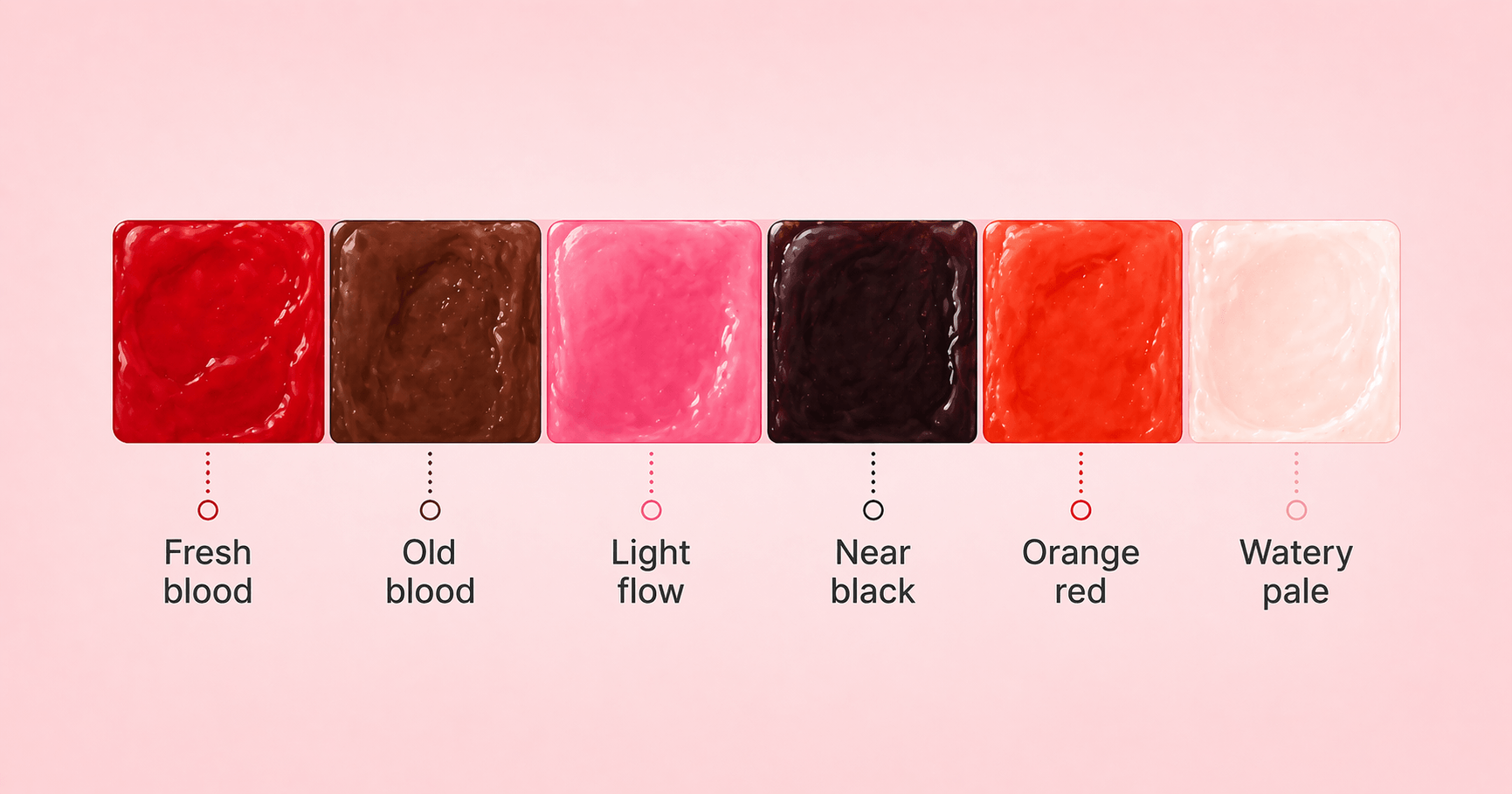
Fresh, fast-moving blood. This is the colour of your heaviest days — usually days 2 and 3 of your period. The flow is brisk enough that haemoglobin has no time to oxidize. Completely normal. Bright red bleeding outside your period — between cycles, after sex, or postmenopausally — is a different story and needs evaluation.
✅ Normal during heavy days🟥 Dark Red / Maroon
Blood that flowed a little more slowly, or pooled briefly before exiting. Very common in the first flow of the morning after lying down overnight. Also typical on day 1 when the period is just getting started. Normal at the start of a period or after a long rest.
✅ Normal — especially first thing in the morning🟤 Brown / Dark Brown
Old blood — oxidized haemoglobin. The blood spent extra time in the uterine cavity or cervical canal before exiting. Extremely common in the 1–2 days before a period (as remnants of the last cycle clear out) and at the end of a period when flow is tapering. Brown spotting mid-cycle that persists for more than a few days, or is accompanied by odour or pain, warrants a check.
✅ Normal at start/end of period or pre-period⚫ Near Black
Highly oxidized old blood — the darkest end of the brown spectrum. Most common at the very end of a period when flow is minimal and blood has moved very slowly. Can also appear at the start in women with a retroverted (tilted back) uterus where flow exits more slowly. Usually normal if it appears only at the tail end of your period and has no odour. Black discharge outside your period, with pain, or persistently is less typical.
✅ Usually normal — end of period🩷 Pink / Light Pink
Blood diluted by cervical fluid — meaning the flow is light enough that normal vaginal discharge is mixing in and thinning it out. Normal at the very start or end of your period, and sometimes at ovulation (in ~5% of women). Persistently pink periods that are lighter and shorter than your normal baseline can indicate low oestrogen — which can happen from significant weight loss, overtraining, perimenopause, or hypothalamic disruption. If pink has replaced your usual red flow over several cycles, mention it to your doctor.
⚠️ Normal at start/end — watch if it replaces full flow🟠 Orange
Orange discharge can be blood mixing with cervical mucus — which can appear briefly at the start of a period and is generally harmless. However, orange discharge with an unusual or unpleasant odour is a potential sign of bacterial vaginosis (BV) or a sexually transmitted infection such as trichomoniasis. The smell is the key distinguishing factor. Orange + odour = see a doctor or sexual health clinic.
⚠️ Watch — normal without odour, investigate with odour🩶 Grey — Take This One Seriously
Grey discharge is not normal at any point in your cycle. It almost always indicates bacterial vaginosis (BV) — a very common, treatable vaginal bacterial imbalance — typically with a strong fishy odour, especially after sex. In someone who is pregnant and experiences grey discharge or grey tissue passing, it can indicate a miscarriage and requires immediate medical attention. BV is easily treated with a short course of antibiotics — but it does not resolve on its own and should not be ignored.
🚨 See a doctor — not normal💧 Watery / Very Pale Pink
A very watery, almost colourless or extremely pale pink period can sometimes indicate iron-deficiency anaemia — when haemoglobin levels are low enough that blood appears thinner and paler. It can also indicate very low oestrogen (hypothalamic amenorrhoea, perimenopause, or significant weight loss). If your previously normal red periods have become consistently watery and pale, it is worth getting a full blood count and ferritin test. Your body may be telling you something important.
⚠️ Investigate if this is a new pattern for youTrack Your Colour — Spot Changes Instantly
Wamiga lets you log flow colour and intensity every day. Over a few cycles, you build a picture of your normal colour pattern — so you notice immediately when something shifts. It takes 10 seconds per day and could save you months of wondering. Free on iOS and Android.
What Affects Period Blood Colour?
Beyond the basic oxidation process, several factors can shift your period colour from cycle to cycle:
- Flow speed: Faster flow = brighter red. Slower flow = darker. This is why heavy days are red and light days are brown.
- Hormonal contraception: Pills, hormonal IUDs, and implants often produce lighter, shorter, darker periods because the uterine lining is thinner and sheds more slowly.
- Fibroids or adenomyosis: Can cause unusually dark or heavy flow with large clots, because blood pools and takes longer to exit the enlarged or distorted uterus.
- Stress: High cortisol can delay ovulation, causing the lining to build up longer than usual — sometimes producing a darker, thicker initial flow.
- Age: Colour tends to shift across your reproductive life. Teenage cycles and perimenopausal cycles are often more variable in colour than cycles in your 20s and 30s.
- Cervical position: A retroverted (tilted back) uterus can cause blood to pool before exiting, making early-period blood appear darker than in women with a forward-tilted uterus.
Quick Reference — At a Glance
- 🔴 Bright red — Normal, heavy days
- 🟥 Dark red/maroon — Normal, start of period or morning
- 🟤 Brown/dark brown — Normal, start/end or pre-period
- ⚫ Near black — Usually normal, end of period
- 🩷 Pink — Normal at edges; watch if replacing full flow
- 🟠 Orange without odour — Usually normal briefly at start
- 🟠 Orange with odour — See a doctor (possible BV/STI)
- 🩶 Grey — Always see a doctor (BV or miscarriage)
- 💧 Watery/very pale — Investigate if a new pattern (anaemia, low oestrogen)
Frequently Asked Questions
What does dark brown period blood mean?
Dark brown period blood is old, oxidized blood — it spent extra time in the uterus or cervical canal, allowing haemoglobin to darken. It is extremely common at the start or end of a period, and as pre-period spotting 1–2 days before full flow. Brown blood lasting more than 3 days, mid-cycle, or with an odour is worth mentioning to a doctor.
What does bright red period blood mean?
Bright red means the blood is fresh and flowing fast — completely normal during your heaviest days. Bright red bleeding between periods, after sex, or postmenopausally is not a period and should be evaluated by a doctor promptly.
Is black period blood normal?
Black period blood is highly oxidized old blood — the darkest end of the brown spectrum. It is most common at the very end of a period when flow is minimal and slow. Usually normal. Black discharge outside of your period, with pain, or with any odour is less typical and deserves assessment.
What does pink period blood mean?
Pink blood is blood diluted with cervical fluid — flow is light enough that normal vaginal discharge is mixing in. Normal at the start or end of a period. Persistently pink periods lighter than your usual baseline can indicate low oestrogen — worth discussing with a doctor if it is a new pattern over several cycles.
What period blood colour is a red flag?
Grey is the most important colour to take seriously — it almost always indicates bacterial vaginosis or, in pregnancy, possible miscarriage. Orange with a fishy or unusual odour can also indicate BV or an STI. Watery, persistently pale pink that replaces your normal flow may indicate anaemia or low oestrogen. These three warrant a doctor's visit.