33%
Peak per-cycle pregnancy probability — achieved only on the 1–2 days before ovulation
<2%
Pregnancy probability the day after ovulation — the egg is already dying within 24 hours
5 days
How long sperm can survive in fertile mucus — start having sex before you think you're ovulating
In this article
The Fertile Window — Day-by-Day Breakdown
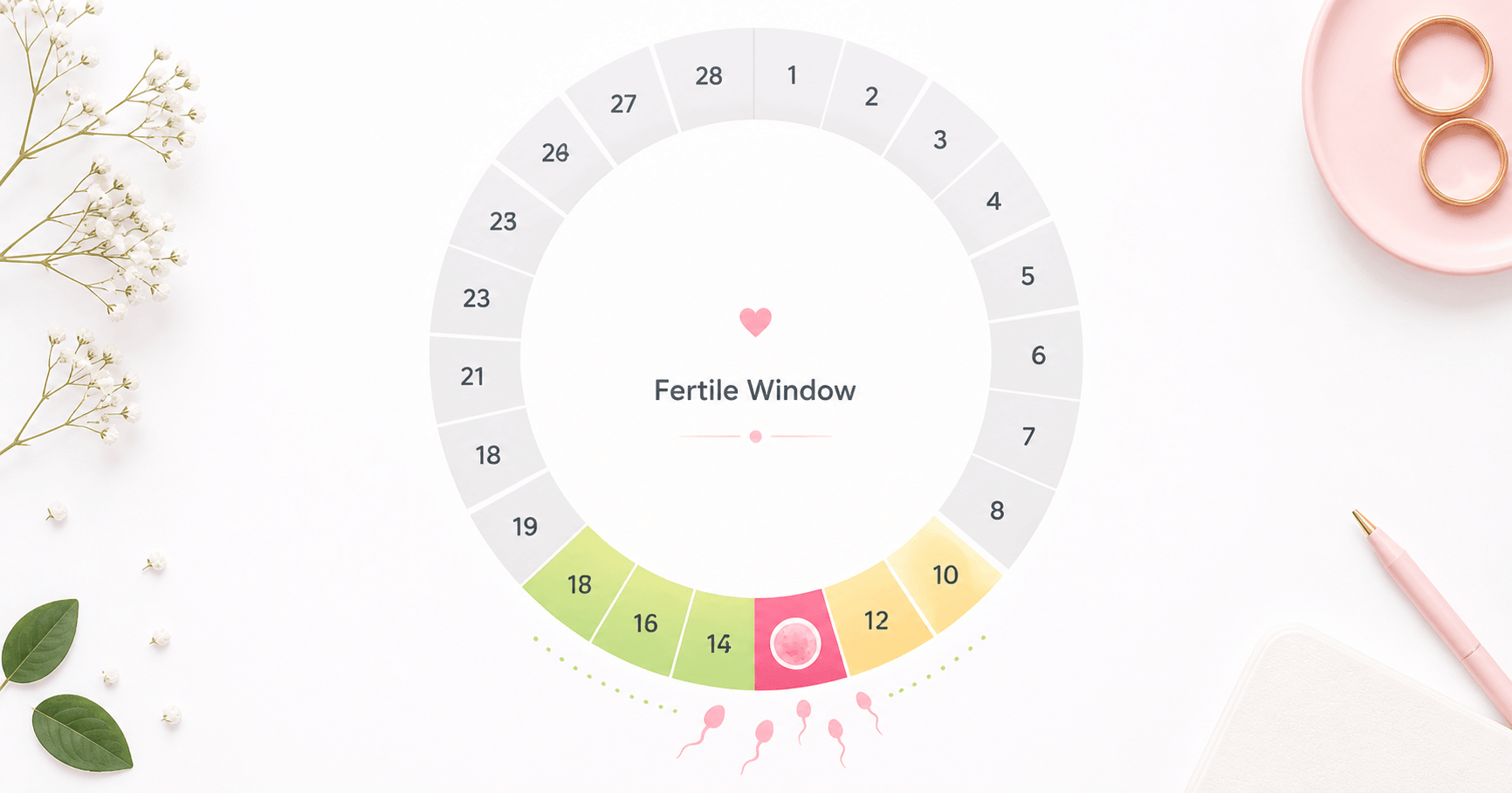
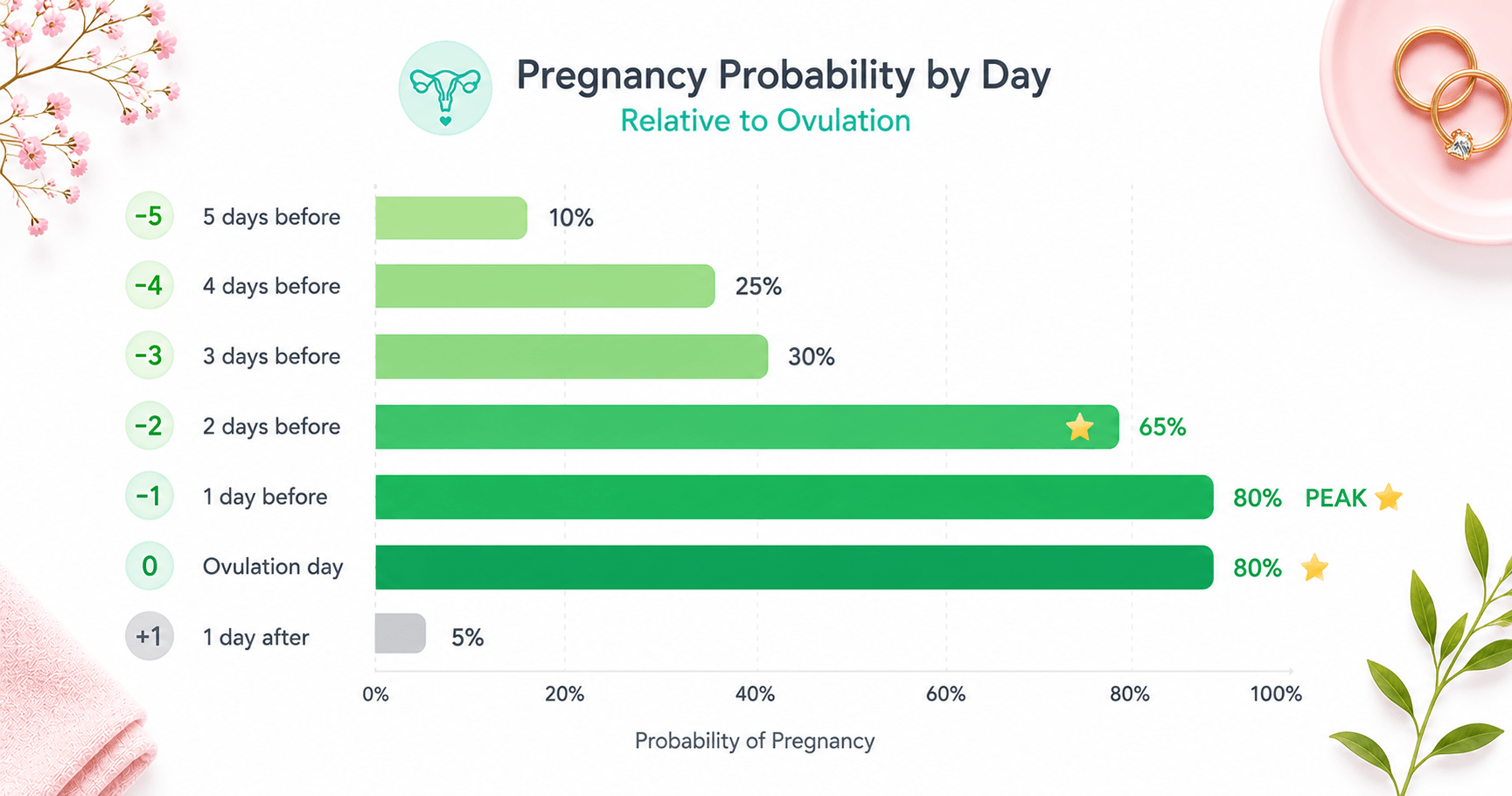
Your fertile window is 6 days long — the 5 days before ovulation plus ovulation day itself. Within that window, not all days are equal. The day before ovulation and two days before ovulation consistently deliver the highest pregnancy probability, because that is when live sperm are already present when the egg arrives.
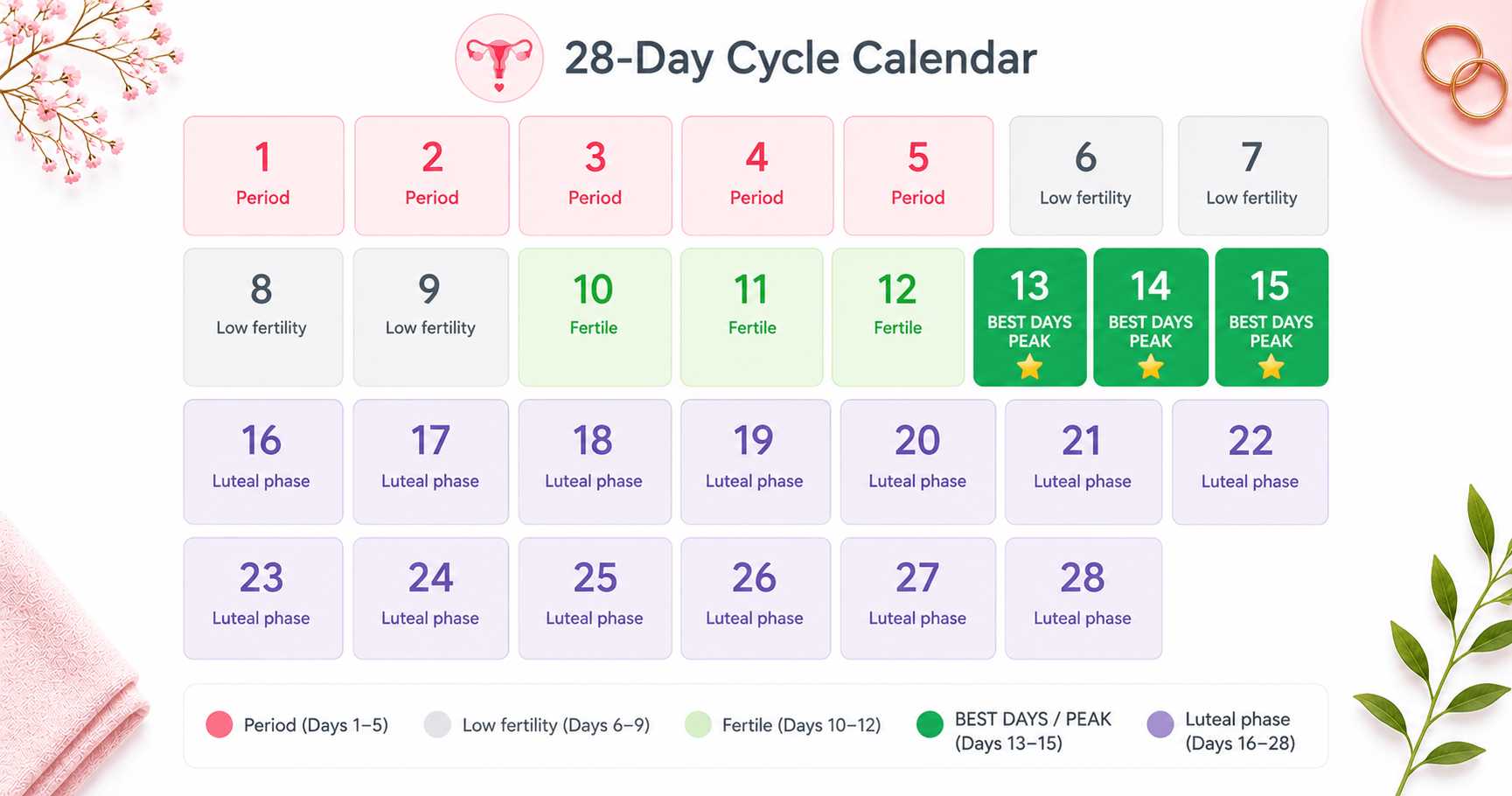
Here is a colour-coded view of a standard 28-day cycle — with the exact days to focus on clearly marked:
Period (Days 1–5)
Follicular / low fertility
Fertile (rising)
Peak fertile ⭐ (best days)
Luteal / post-ovulation
1
Period
2
Period
3
Period
4
Period
5
Period
6
Low
7
Low
8
Low
9
Low
10
Fertile
11
Fertile
12
Fertile
⭐
13
BEST
⭐
14
PEAK
⭐
15
BEST
16
Luteal
17
Luteal
18
Luteal
19
Luteal
20
Luteal
21
Luteal
22
Luteal
23
Luteal
24
Luteal
25
Luteal
26
Luteal
27
Luteal
28
Luteal
Example 28-day cycle. Ovulation on Day 14 — peak days are Days 12, 13, 14 (⭐). Your cycle will differ.
The critical rule: once ovulation is confirmed (temperature rise, LH surge has passed), the window is closing. The egg released at ovulation survives only 12–24 hours. All the benefit comes from having sex before the egg is released, so that sperm are already present in the fallopian tube waiting for it.
Why Day 14 is not the universal answer: Ovulation on Day 14 is only true for a perfect 28-day cycle. In reality, cycle length varies month to month, and ovulation day shifts accordingly. Relying on Day 14 without tracking causes many couples to miss their actual window. Your real ovulation day must be detected — not assumed.
Your Fertile Window by Cycle Length
The luteal phase (from ovulation to next period) is relatively fixed at 12–14 days for most women. This means your ovulation day is approximately your cycle length minus 14. Here is the full breakdown — use your average cycle length to find your estimated fertile window and best days to have sex:
| Cycle Length | Est. Ovulation | Fertile Window | Best Days to Have Sex | Start OPK Testing |
|---|---|---|---|---|
| 21 days | Day 7 | Days 2–7 | Days 5, 6, 7 | Day 4 |
| 24 days | Day 10 | Days 5–10 | Days 8, 9, 10 | Day 6 |
| 26 days | Day 12 | Days 7–12 | Days 10, 11, 12 | Day 8 |
| 28 days ★ | Day 14 | Days 9–14 | Days 12, 13, 14 | Day 10 |
| 30 days | Day 16 | Days 11–16 | Days 14, 15, 16 | Day 11 |
| 32 days | Day 18 | Days 13–18 | Days 16, 17, 18 | Day 12 |
| 35 days | Day 21 | Days 16–21 | Days 19, 20, 21 | Day 15 |
★ Most common. These are estimates — detect your actual ovulation with OPK strips for precision. Cycle length varies month to month.
Important: These are averages. Even if your cycle is usually 28 days, ovulation can shift to Day 11 or Day 17 in a given month due to stress, illness, or sleep disruption. Calendar estimation alone is unreliable — always cross-reference with ovulation detection methods.
5 Signs You Are in Your Peak Fertile Window Right Now
Knowing your estimated window from the table is a starting point. The following real-time signs confirm you are actually in it — especially the first two, which are the most reliable:
Positive OPK Strip
Your LH surge is detected — ovulation will occur in the next 24–36 hours. This is your clearest, most reliable real-time signal. Have sex today and tomorrow.
Reliability: Very HighEgg-White Cervical Mucus
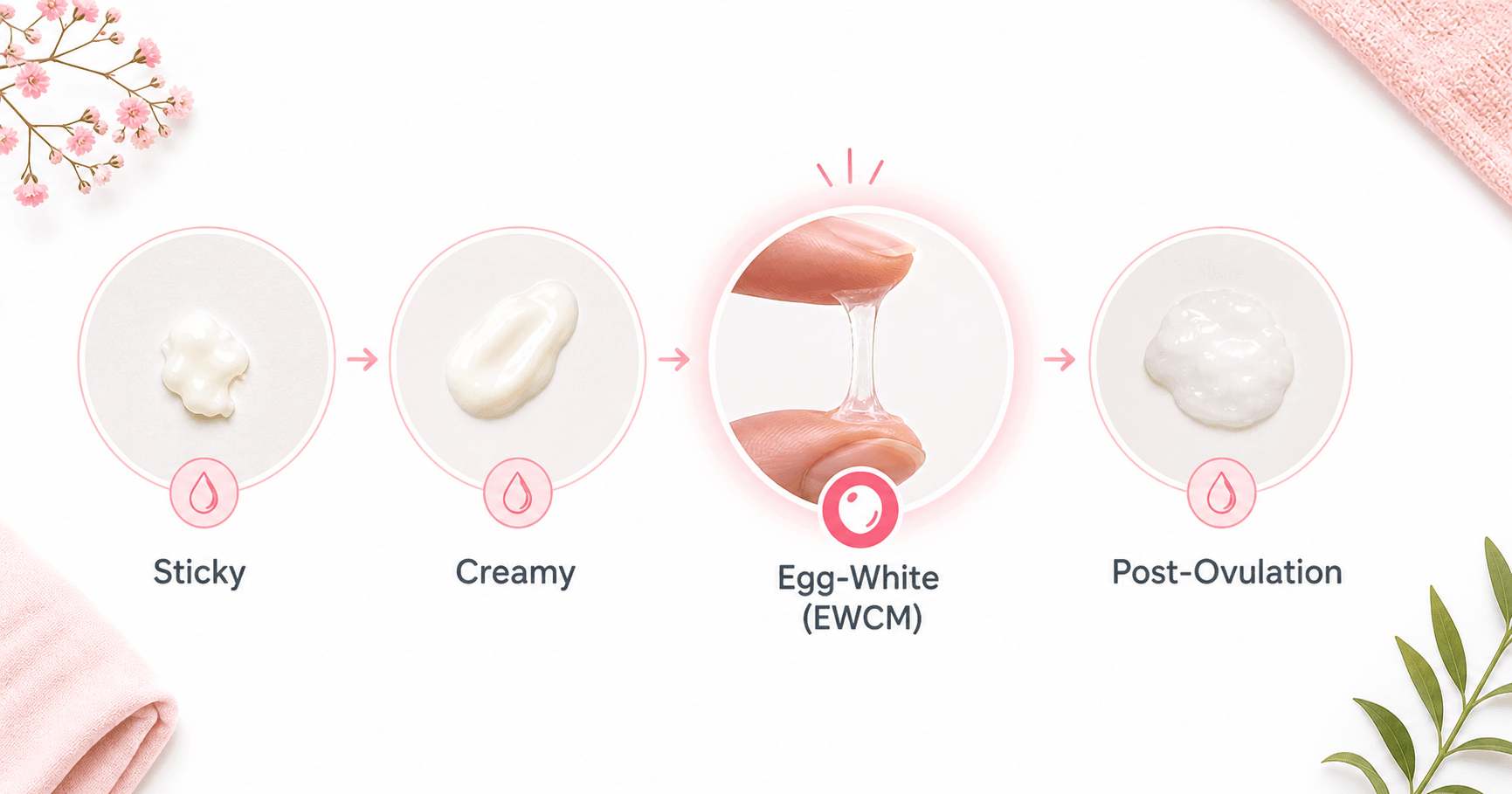
Clear, very stretchy, slippery discharge — like raw egg white. This is the body's natural fertility lubricant, and it signals the fertile window is open. Sperm survive longest in EWCM.
Reliability: HighPre-Ovulation BBT Dip
Some women notice a slight temperature drop just before ovulation, followed by the sustained rise 24–48 hours after. The dip is a subtle predictor — not reliable alone, but useful with other signs.
Reliability: SupportiveMild Pelvic Twinge (Mittelschmerz)
One-sided pelvic cramping or ache at mid-cycle — caused by the follicle stretching or rupturing. About 20% of women experience it. A useful sign, but only when combined with mucus/OPK.
Reliability: Good when combinedIncreased Energy & Libido
Estrogen peaks just before ovulation — you may notice a distinct lift in mood, energy, social drive, and sexual desire. Many women describe this as a predictable monthly "high." A real biological signal, but too subjective to rely on alone.
Reliability: SupportiveSoft, Open Cervix
Around ovulation the cervix rises higher, becomes softer, and the os (opening) widens slightly. This is detectable by self-examination — a useful add-on sign but requires learning your baseline over several cycles.
Reliability: Good with practiceLog OPK results, mucus, and BBT in Wamiga daily — the AI combines all three signals to give you a real-time fertility score and pinpoints your peak 2-day window with a notification. Try Wamiga free →
Your Month-by-Month Action Plan
Here is exactly what to do each cycle, from Day 1 of your period to the end of your fertile window:
Day 1 — Period starts. Calculate your start-testing day.
Note that today is Day 1. From your last few cycles, estimate your usual ovulation day (cycle length minus 14). Subtract 5 from that — that's when you start OPK testing this cycle. Example: 28-day cycle → ovulation ~Day 14 → start testing Day 9.
Day 5 onward — Begin watching cervical mucus daily.
After your period ends, check cervical mucus each morning before washing. Note whether it's dry, sticky, creamy, or watery. You're looking for the transition to clear and stretchy (EWCM) which signals the fertile window opening.
Start OPK testing — test once daily, afternoon preferred.
Test around 2 pm daily — LH peaks mid-morning and shows up in urine 2–3 hours later, making early afternoon the optimal testing window. Use the same time each day. A test line as dark or darker than the control line = positive.
Fertile mucus appears? Start having sex every other day.
As soon as you see watery or stretchy mucus — even before your first positive OPK — begin having sex every 1–2 days. You want sperm present before the LH surge, not after. Don't wait for the peak sign.
OPK turns positive — have sex today and tomorrow. Priority 1.
A positive OPK means ovulation is 24–36 hours away. This is your most important 2-day window. Have sex today (the positive day) and the following day. If you can, also the day after that — egg-white mucus may still be present.
Confirm with BBT — temperature rises after ovulation.
The morning after ovulation, your resting temperature rises 0.2–0.5°C and stays elevated. This confirms ovulation happened. Your fertile window is now closed for this cycle. Note which cycle day this was — it helps you predict next month's window more accurately.
Does Time of Day Matter?
This is one of the most Googled questions about timing — and the honest answer is: almost certainly not enough to matter.
Some studies have found that sperm quality is marginally higher in the morning — testosterone peaks in the morning and some research links this to slightly higher sperm count and motility in early morning samples. However:
- The differences are small and inconsistent across studies
- No large, well-controlled study has shown morning sex leads to higher natural conception rates
- The cycle day you have sex matters orders of magnitude more than the hour
Practical advice: Have sex at whatever time of day works for you and your partner. Trying to force a specific time of day when you're tired, stressed, or it's inconvenient can add anxiety that is counterproductive. Consistency on the right cycle days is what matters — not the hour of the clock.
5 Timing Mistakes That Cost You a Cycle
These are the most common errors that cause otherwise fertile couples to miss their window month after month:
1. Waiting until you "feel" you're ovulating
By the time most women notice ovulation symptoms (mittelschmerz, temperature rise), ovulation has already occurred or the egg is in its final hours. You need sperm waiting — not racing to catch up.
Fix: Start having sex 5 days before estimated ovulation2. Assuming Day 14 every month
Even regular cycles shift by 2–4 days month to month. Ovulation on Day 10 one cycle and Day 17 the next is completely normal. Fixed-calendar timing misses real ovulation constantly.
Fix: Use OPK strips every cycle — don't rely on calendar alone3. Having sex only once during the window
One timed session gives you one shot. The fertile window spans up to 6 days and sperm need time to capacitate (mature) before they can fertilise an egg. Multiple sessions across the window dramatically improves odds.
Fix: Every 1–2 days throughout the full 5-day fertile window4. Using lubricants that harm sperm
Most commercial lubricants — including KY Jelly, Vaseline, saliva, and olive oil — are toxic to sperm motility. If you need lubrication, use fertility-safe options: Pre-Seed, Conceive Plus, or canola oil.
Fix: Use only sperm-safe lubricants (Pre-Seed, Conceive Plus)5. Stopping sex once the OPK turns negative
The OPK turns negative after the LH surge — but ovulation may not have occurred yet, or the egg may still be viable. Continue having sex for one more day after the positive OPK to ensure full coverage.
Fix: Have sex the positive day and the 2 following days6. Ignoring male factor
Even perfectly timed sex fails if sperm quality is poor. Male factor contributes to ~50% of infertility cases. Extended abstinence, tight underwear, heat exposure, and smoking all affect sperm quality significantly.
Fix: Both partners should optimise — semen analysis if trying 6+ monthsStarting After Contraception — When Is the Best Time?
Fertility returns at different speeds depending on which contraception you were using:
Combined Pill / Mini-Pill
1–3 monthsMost women ovulate within 1–3 months of stopping. Some ovulate the very next cycle. You can start trying immediately after your last pill pack — no need to wait.
Hormonal IUD / Implant
1–3 monthsFertility typically returns quickly after removal — within 1–3 months. Some women ovulate within weeks. Track carefully as your cycle may be irregular for the first month or two.
Depo-Provera Injection
6–18 monthsThe injection has the longest return-to-fertility timeline — on average 9–10 months after the last injection, though this varies significantly between individuals. Plan ahead if using this method.
For all methods except Depo-Provera, you can start tracking and trying immediately. Your cycle may be irregular for 1–3 months while hormones normalise, so OPK strips are especially important in this transition period — your body may not follow a predictable calendar.
For a full guide on what to expect, see When Will My Period Return After Stopping the Pill?
Sources & Further Reading
The guidance in this article is informed by reputable medical and public-health organizations:
Frequently Asked Questions
What is the best time of day to have sex to get pregnant?
Sperm quality is marginally higher in the morning for some men, but no well-controlled study has shown that time of day significantly affects natural conception rates. The cycle day matters far more than the hour. Have sex at whatever time is most convenient and relaxed for both partners — consistently, during the right fertile window days.
Is it better to have sex before or on ovulation day?
Before ovulation is better. The day before ovulation and two days before consistently give the highest pregnancy probability (up to 33% per cycle, per Wilcox et al.). Having sex only on ovulation day gives a lower chance because the egg may already be past its 12–24-hour viable window by the time sperm complete the journey to the fallopian tube.
How do I know when I'm most fertile?
The most reliable approach is to combine two methods: use an ovulation predictor kit (OPK) to detect your LH surge — which occurs 24–36 hours before ovulation — and check daily for egg-white cervical mucus (clear, stretchy, slippery discharge). When both are positive simultaneously, you are in your peak 1–2-day window.
When should I start having sex each cycle when trying to conceive?
Start having sex every other day from about 5 days before your estimated ovulation date. In a 28-day cycle, begin around Day 9–10. For a 24-day cycle, start around Day 6–7. Starting early ensures sperm are already present when the egg is released — don't wait until you get a positive OPK to begin.
Can I get pregnant if I have sex after ovulation?
It is very unlikely. The egg survives only 12–24 hours after ovulation. If ovulation has already occurred and more than 24 hours have passed, the fertile window is closed for that cycle. This is why timing intercourse before ovulation is so critical — sperm need to be waiting for the egg, not trying to catch it.