Seconds
How long the actual egg release takes — from follicle rupture to exit
12–24 hrs
How long the egg stays viable and can be fertilised after release
6 days
The total fertile window created by ovulation each cycle
In this article
- The direct answer — three different time frames
- Hour-by-hour ovulation timeline
- Duration of every ovulation signal
- What physically happens during ovulation
- Pregnancy probability by day relative to ovulation
- How long each ovulation sign lasts
- How to know ovulation is over
- When ovulation timing signals a problem
- Frequently asked questions
The question "how long does ovulation last?" has three completely different correct answers depending on what you are actually asking — and confusing them leads to missed fertile days, unnecessary worry, or poorly timed intercourse. Let's be precise.
The Direct Answer — Three Different Time Frames
The egg release itself: 15 seconds to a few minutes. The follicle ruptures and the egg exits — this is the literal "moment" of ovulation. Most women feel nothing.
The egg's viability window: 12–24 hours. After release, the egg travels into the fallopian tube and can only be fertilised during this window. After 24 hours it disintegrates.
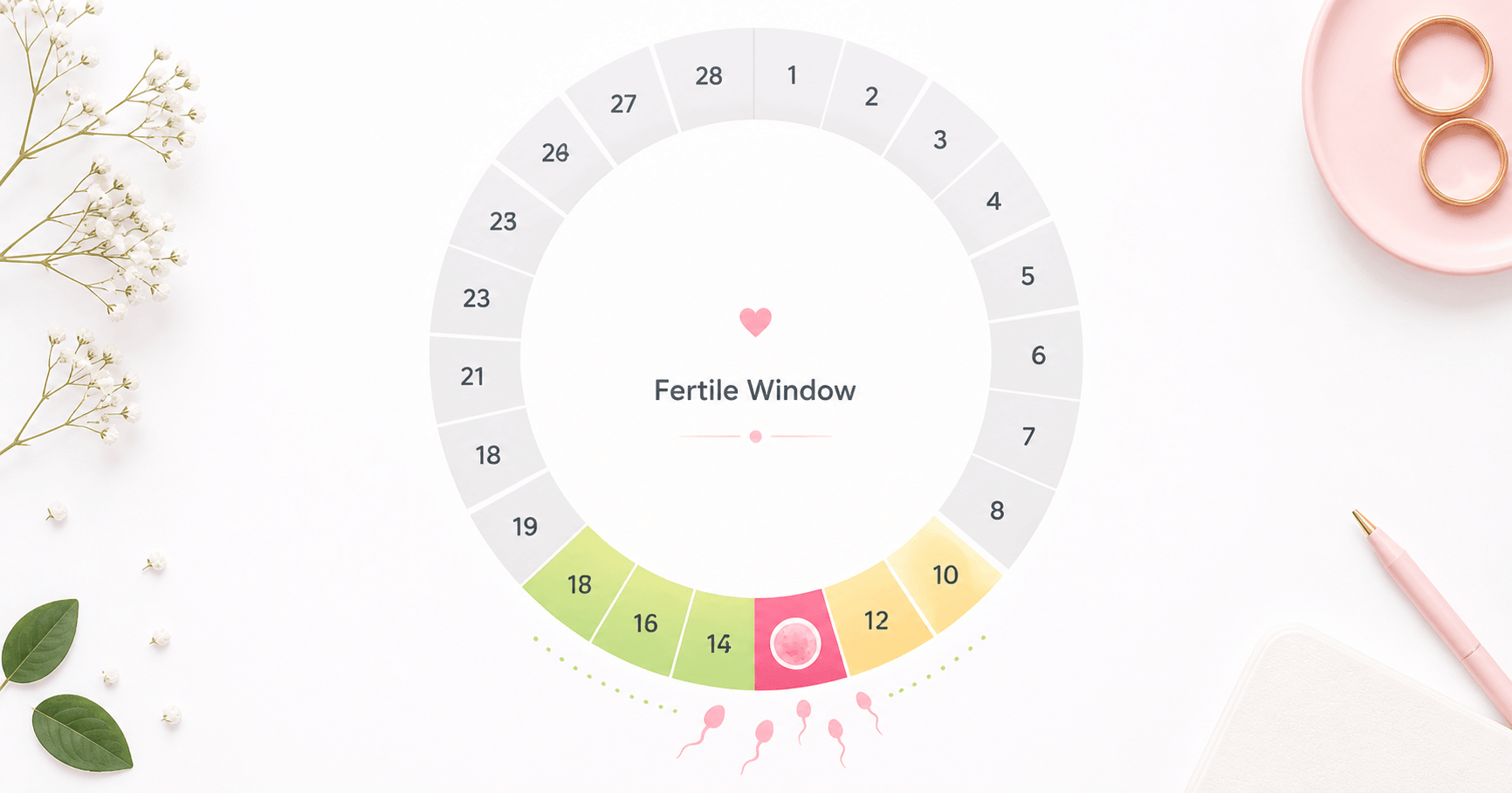
The fertile window ovulation creates: 6 days — the 5 days before ovulation (when sperm can wait) plus ovulation day. This is the window that actually determines your conception chances each cycle.
When most people ask "how long does ovulation last?" they are really asking one of these three questions. The egg's viability window — 12 to 24 hours — is usually the most practically useful answer.
Hour-by-Hour Ovulation Timeline
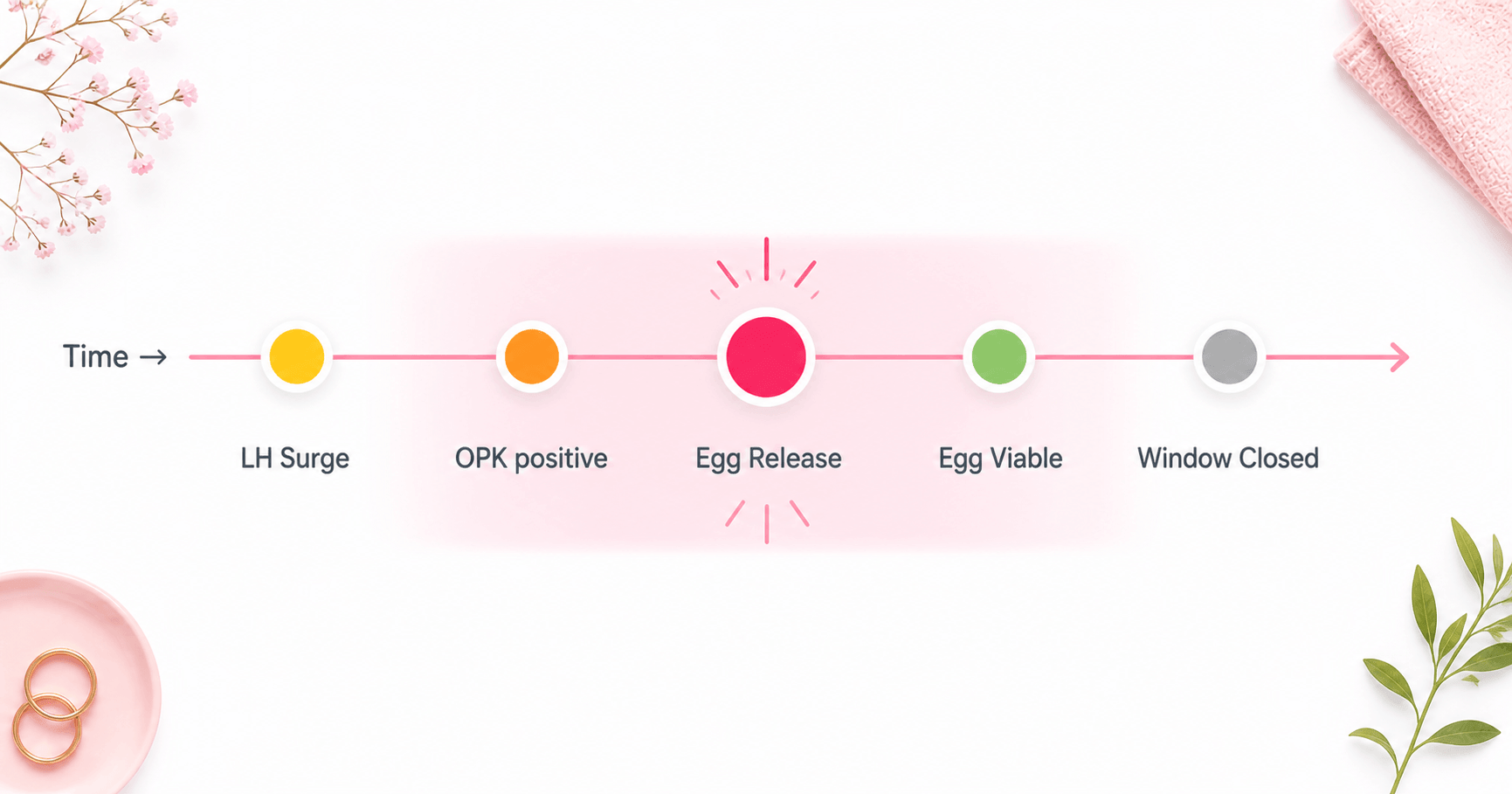
Ovulation does not happen in an instant — it is the final event in a carefully orchestrated hormonal sequence that unfolds over roughly 36–40 hours. Here is what happens at each stage.
From LH surge to the end of the fertile egg window
LH Surge rising
LH Peak & Rupture
Egg viable — peak fertility
Egg aging — window closing
Hour 0
LH surge begins
LH starts rising in blood & urine. OPK not yet positive.
Hour 12
OPK turns positive
LH detectable on strips. EWCM often peaks now.
Hour 24–36
Follicle ruptures
Egg is released. Mittelschmerz may occur. Lasts seconds.
Hour 36–48
Peak egg viability
Egg in fallopian tube. Fertilisation most likely if sperm present.
Hour 48–60
Egg aging
Viability declining. Fertilisation still possible but riskier.
Hour 60
Window closes
Egg disintegrates. Corpus luteum forms. Cycle sealed.
← Swipe to scroll on mobile
Duration of Every Ovulation-Related Signal
Ovulation is not just the egg release — it triggers a cascade of changes across hormones, cervical mucus, and body temperature. Each signal has its own duration.
What Physically Happens During Ovulation — Step by Step
Understanding the mechanics of ovulation makes the timing intuitive rather than something you have to memorise.
1
Follicle-stimulating hormone (FSH) recruits a dominant follicle
Days 1–10 of the cycle
FSH rises at the start of the cycle and stimulates several follicles in the ovaries to grow. By around day 7–10, one follicle becomes dominant — it grows faster and produces more estrogen, suppressing the others. This dominant follicle will release the egg.
2
Estrogen peak triggers the LH surge
~36 hours before ovulation
When the dominant follicle reaches 18–24mm and estrogen peaks, the pituitary gland responds with a sudden surge of luteinising hormone (LH). This is the trigger — it initiates a cascade of changes inside the follicle that will lead to rupture. This is what LH test strips detect.
3
The follicle wall thins and ruptures
24–36 hours after LH surge
LH activates enzymes that break down the follicle wall. Prostaglandins cause smooth muscle contractions. The follicle surface weakens at one point (the stigma), bulges outward, and ruptures — releasing the egg, follicular fluid, and sometimes a small amount of blood. This takes seconds to minutes.
4
The egg is swept into the fallopian tube
Minutes after rupture
The fimbriae — finger-like projections at the end of the fallopian tube — sweep the egg from the ovarian surface into the tube. The egg is surrounded by a layer of cumulus cells that help sperm penetrate it. The egg begins its 12–24 hour viability window from this moment.
5
The follicle becomes the corpus luteum
Within hours of ovulation
The empty follicle left behind immediately transforms into the corpus luteum. This temporary gland rapidly begins producing progesterone, which thickens cervical mucus (blocking further sperm), raises basal body temperature, and prepares the uterine lining for a possible implanting embryo.
Pregnancy Probability by Day Relative to Ovulation
Studies tracking the timing of intercourse relative to confirmed ovulation show a clear pattern: the closer to (but before) ovulation, the higher the probability. Here is the data.
Key insight: The two highest-probability days are Day −1 and Day −2 — not ovulation day itself. This is because sperm that arrive a day or two early are already waiting in the fallopian tubes when the egg arrives. Waiting until you feel or detect ovulation and then having sex means you are likely one day late for peak probability.
How Long Each Ovulation Sign Lasts
Each physical ovulation signal has a different duration. Knowing how long each lasts helps you interpret your body correctly and avoid false confidence or false alarm.
Positive LH test strip
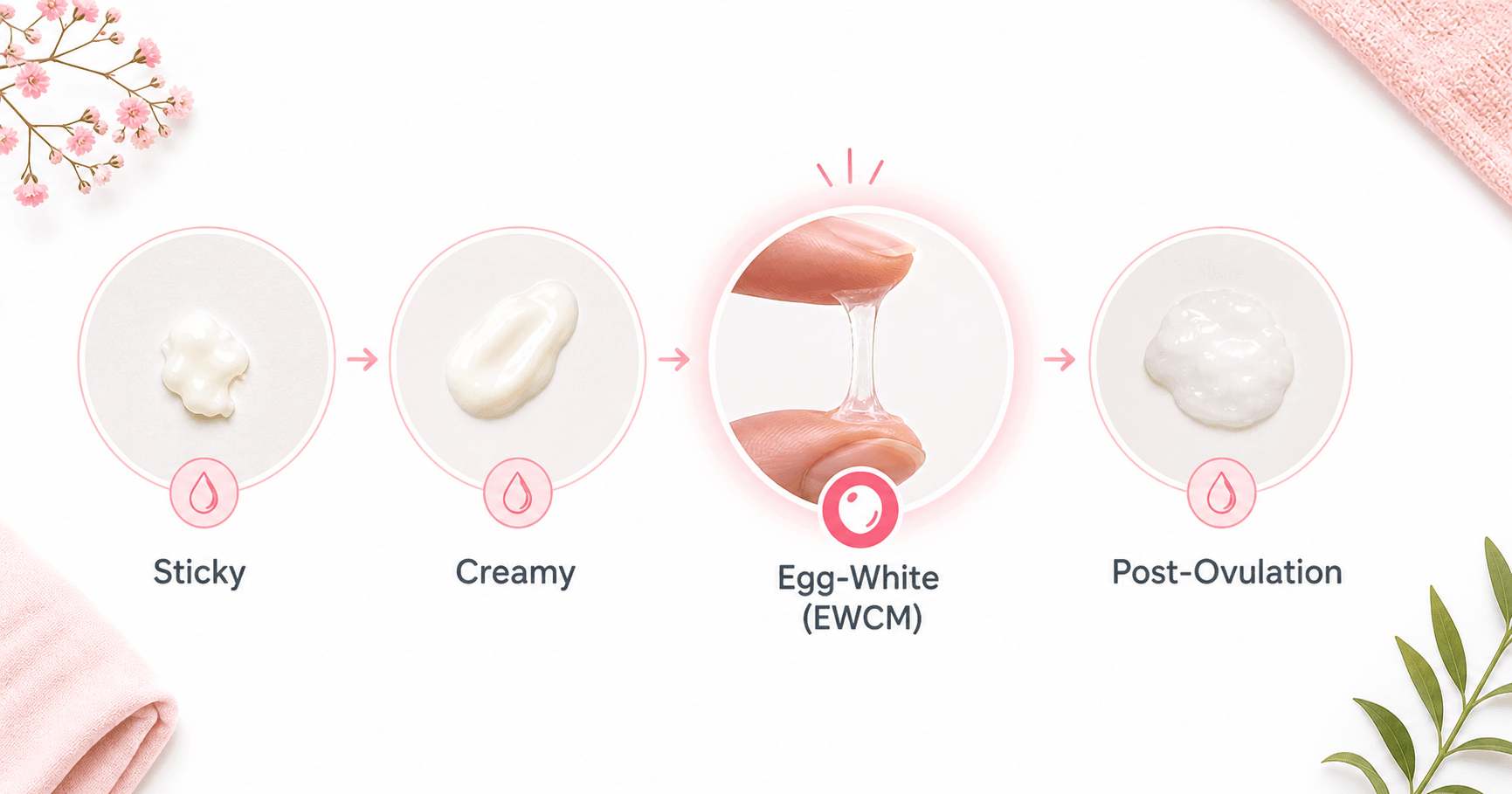
Egg-white cervical mucus
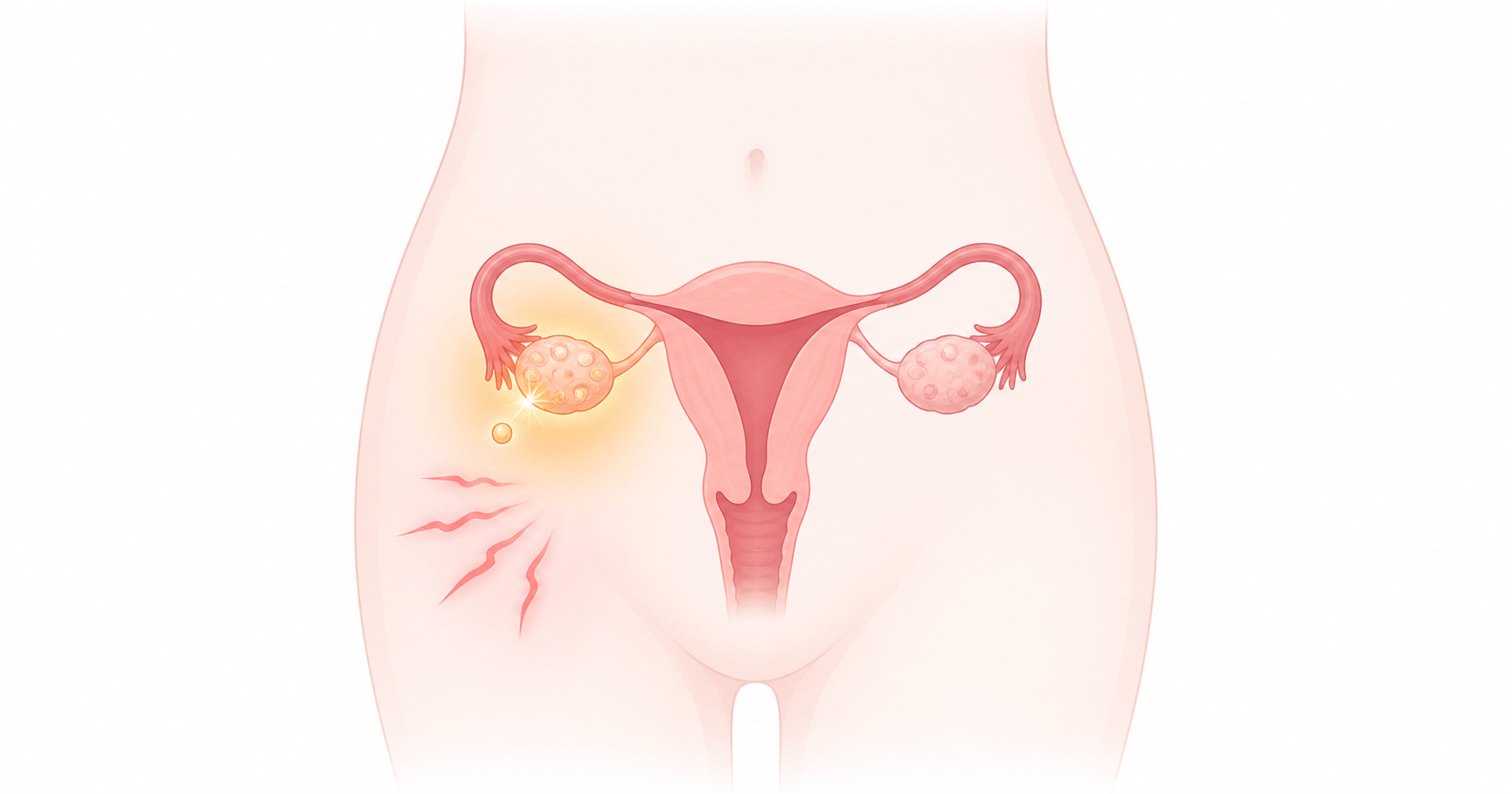
Mittelschmerz (ovulation pain)
BBT pre-ovulation dip
Increased libido
Ovulation spotting
How to Know Ovulation Is Over
Once ovulation is complete, your body switches from the estrogen-dominant follicular phase to the progesterone-dominant luteal phase — and that shift produces several observable changes within 24–48 hours.
- Cervical mucus returns to thick, sticky, or dry. The abrupt change from stretchy EWCM to thick cloudy mucus is the clearest sign. Progesterone creates a mucus plug that seals the cervix. The transition typically happens within 12–36 hours of ovulation.
- BBT rises and stays elevated. A sustained rise of 0.2–0.5°C that persists for at least 3 days confirms ovulation has occurred. This temperature plateau lasts the entire luteal phase (12–14 days).
- LH drops below the positive threshold. The LH surge falls sharply after the follicle ruptures. OPK strips that were positive will return to negative within 24–48 hours of the peak.
- Mittelschmerz pain resolves. If you experienced ovulation pain, it fades as the peritoneal fluid is reabsorbed. Ongoing pain after 48 hours should be investigated.
- Cervix position changes. The cervix, which was high, soft, and open at peak fertility, lowers, firms, and closes within 1–2 days after ovulation — a sign of rising progesterone.
When Ovulation Timing Signals a Problem
Most women ovulate within a predictable window each cycle. These patterns warrant a conversation with your doctor.
No positive LH result after daily testing
If you test daily from day 8 for a full cycle and never see a positive OPK, you may not be ovulating (anovulation). Test twice daily and rule out testing errors before assuming anovulation — then see a GP for blood tests.
No BBT rise in the second half of the cycle
A luteal phase with no temperature rise across 3+ cycles suggests anovulation or a luteal phase defect — insufficient progesterone production after ovulation. A progesterone blood test on day 21 (of a 28-day cycle) can confirm whether ovulation occurred.
LH surge but no confirmed ovulation
A condition called Luteinised Unruptured Follicle (LUF) syndrome causes the follicle to luteinise and produce progesterone without actually releasing the egg. LH strips appear positive but no ovulation occurs. Confirmed by ultrasound monitoring.
Luteal phase shorter than 10 days
A short luteal phase (BBT stays elevated for fewer than 10 days) may not allow enough time for a fertilised egg to implant before progesterone drops. This is associated with early pregnancy loss and fertility challenges — worth discussing with a reproductive specialist.
Frequently Asked Questions
How long does ovulation last?
The moment of egg release takes 15 seconds to a few minutes. The egg then remains viable for 12–24 hours. The full fertile window — including the days sperm can survive waiting — spans 6 days. These are three distinct time frames, and the most practically useful one is the 12–24 hour egg viability window, which determines how narrowly you need to time intercourse after ovulation day.
How long does the LH surge last before ovulation?
The LH surge typically begins 24–48 hours before ovulation and peaks 10–12 hours before the egg is released. A positive OPK (LH test strip) signals that ovulation will occur within 12–36 hours. The surge remains detectable for about 24–48 hours total before dropping.
Can you feel when ovulation is happening?
About 20% of women feel mittelschmerz — a brief one-sided lower abdominal twinge — at the moment of ovulation. Most women feel nothing at the exact moment of egg release. The days leading up to ovulation are more commonly felt through rising estrogen effects: increased cervical discharge, breast tenderness, and heightened libido.
How long after ovulation can you still get pregnant?
Pregnancy requires the egg to be fertilised, which can only happen while the egg is viable — 12–24 hours after release. Intercourse more than 24 hours after ovulation cannot result in pregnancy in that cycle. This is why timing intercourse in the 1–3 days before predicted ovulation gives significantly higher success rates than waiting for ovulation day itself.
How do you know when ovulation is over?
The clearest signs ovulation is complete: EWCM returns to thick or dry, basal body temperature rises by 0.2–0.5°C and stays elevated, LH strips return to negative, any mittelschmerz pain has resolved, and the cervix lowers and firms. All of these changes typically occur within 24–48 hours of egg release.
Sources & Further Reading
The guidance in this article is informed by reputable medical and public-health organizations: