99%+
Accuracy for detecting the LH surge — when tested correctly at the right time of day
24–36h
Time between your positive OPK and ovulation — your peak 2-day conception window
2 pm
Optimal testing time — LH produced in the morning shows up in urine 2–3 hours later
In this article
- What OPKs detect and how they work
- How to read the results — positive vs negative
- The LH surge timeline
- Step-by-step: how to use OPK strips
- When to start testing (by cycle length)
- What to do after a positive OPK
- OPK types compared
- 6 mistakes that ruin your results
- When OPKs don't work reliably
- Frequently asked questions
What OPKs Detect and How They Work
An ovulation predictor kit measures the level of luteinising hormone (LH) in your urine. LH is always present in small amounts, but it surges dramatically — sometimes 3–10× baseline — in the 24–48 hours before an egg is released from the ovary. This is called the LH surge, and it is what OPKs are designed to catch.
When your OPK detects this surge, it gives you a positive result and a reliable 24–36 hour warning that ovulation is imminent. This is the most actionable fertility signal available without a blood test or ultrasound — and with modern strips costing under £20 for 50 tests, it is accessible to everyone.
OPK vs pregnancy test: An OPK is not a pregnancy test. A positive OPK means your LH has surged and you are about to ovulate. It says nothing about whether pregnancy has occurred. Conversely, hCG (the pregnancy hormone) can sometimes trigger a faint positive on an OPK — so do not use OPKs to test for pregnancy.
How to Read OPK Results — Positive vs Negative
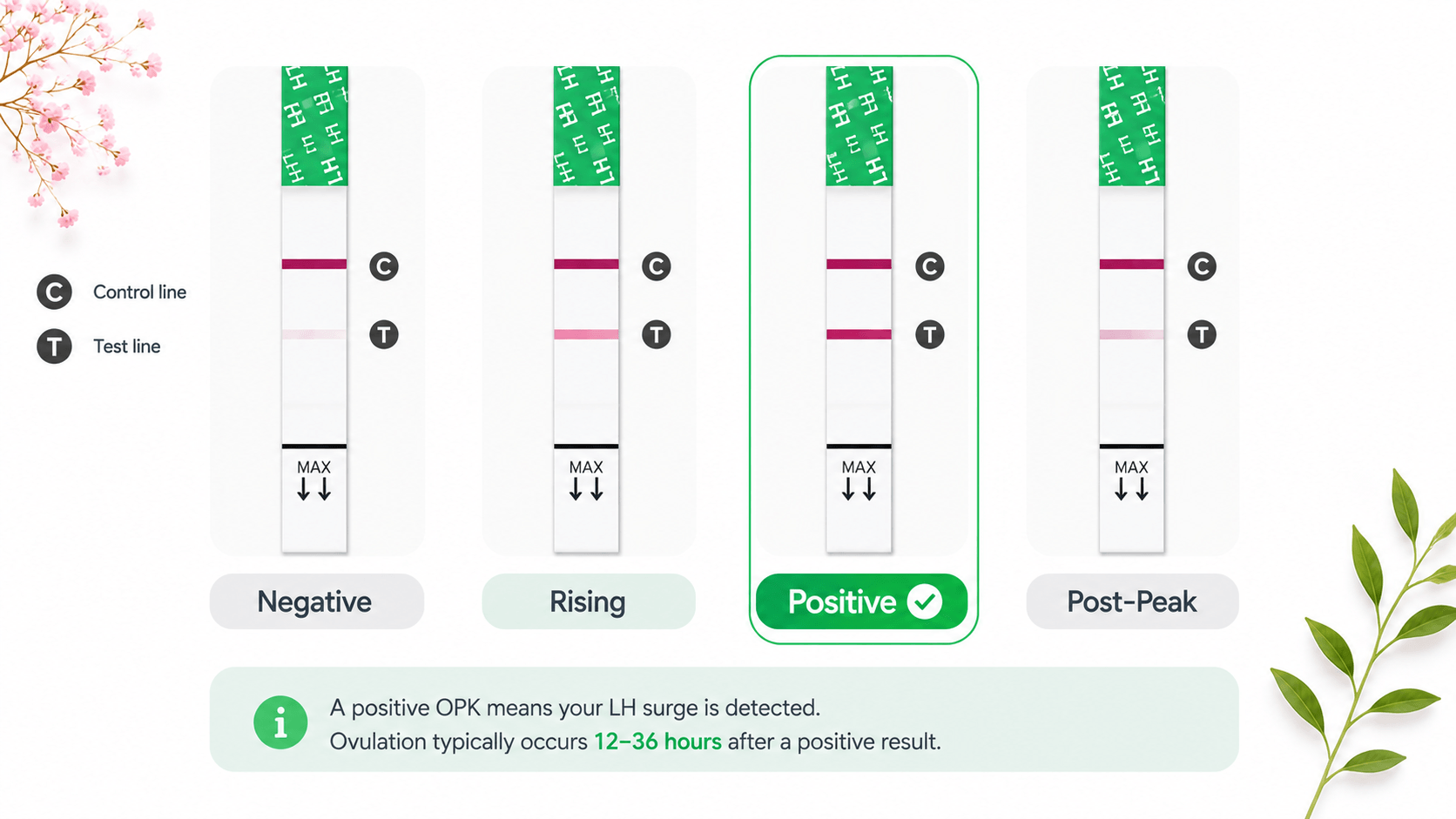
Most OPK strips have two lines: a Control line (C) that always appears when the test is valid, and a Test line (T) that shows the LH level. The one rule that trips up most people:
✅ POSITIVE = Test line (T) is as dark as OR darker than the Control line (C). Anything lighter = negative.
Here are the four result stages you will see across your cycle:
C
T
Negative
T much lighter than C. LH low — fertile window not yet open.
C
T
Rising
T noticeably darker but still lighter than C. LH rising — test twice daily now.
C
T
✅ POSITIVE
T as dark or darker than C. LH surging — have sex today and tomorrow!
C
T
Post-Peak
T lighter again. LH falling — ovulation has likely occurred. Fertile window closing.
← Scroll to see all four result stages →
Common mistake: Many people see any visible test line and assume it's positive. A faint or medium test line that is still lighter than the control line is a negative result. Keep testing daily — your surge is coming.
The LH Surge Timeline
Understanding the shape of your LH surge helps you know when to test and what to expect after a positive result:
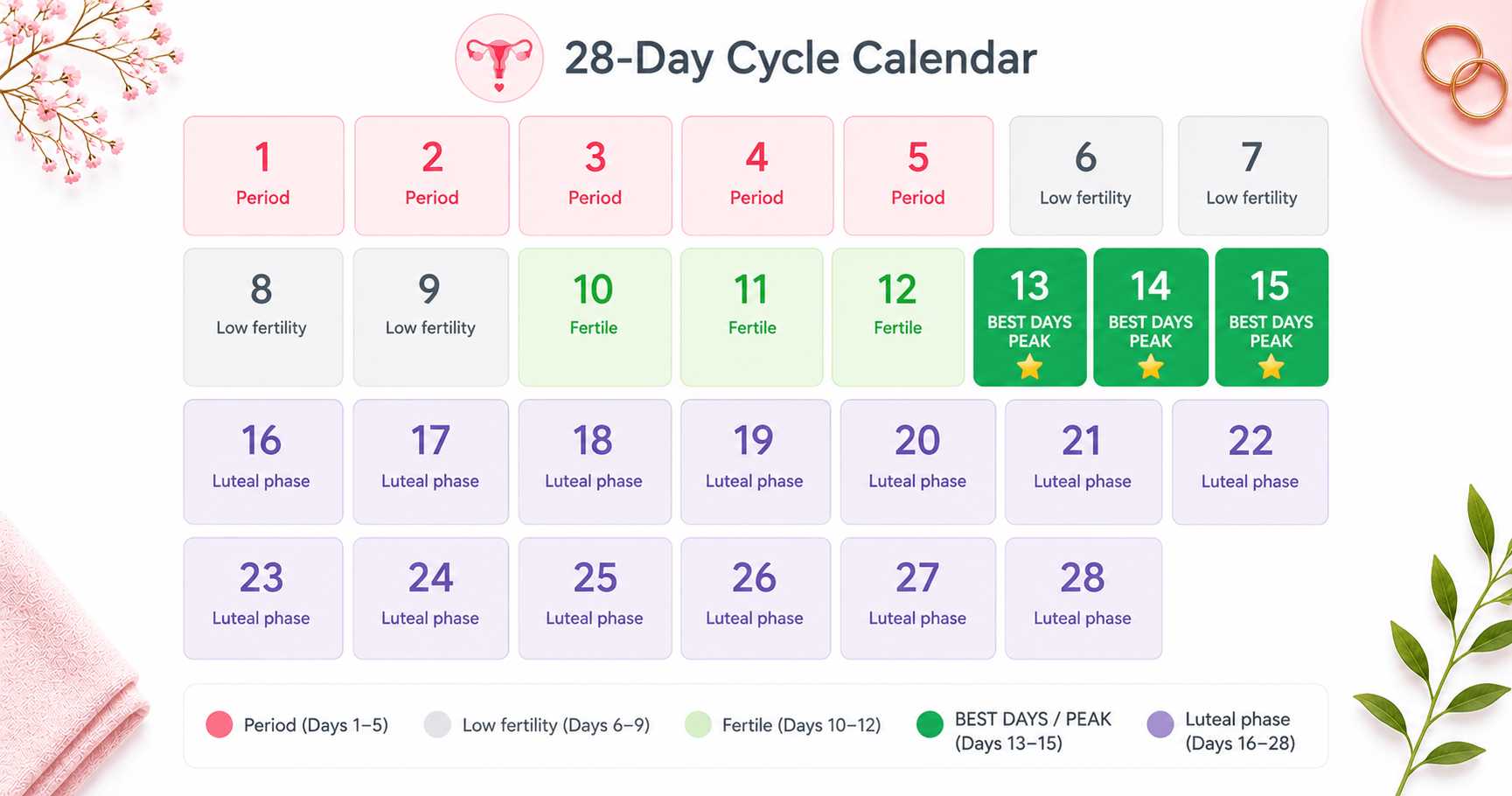
Day 9
Day 10
Day 11
Day 12
Day 13 ⭐
Day 13 pm
Day 14
Day 14 pm
Day 15
First +OPK
Have sex
Have sex
Ovulate
← Scroll to see full timeline — example 28-day cycle →
The LH surge typically lasts 12–48 hours before ovulation occurs. Some women have a brief, sharp surge that shows as positive for only 12–16 hours — which is why testing twice daily (morning and early afternoon) during your estimated fertile window prevents you from missing a short peak entirely.
Step-by-Step: How to Use OPK Strips
1
Collect urine in a clean cup (don't test directly in the stream)
Most strip OPKs require dipping into a cup rather than holding under the urine stream. Collect a small amount of urine in a clean, dry container. Do not use first morning urine — test between 10 am and 2 pm for best accuracy.
2
Reduce fluid intake 2 hours before testing
Avoid drinking large amounts of water or other liquids for 1–2 hours before testing. Diluted urine reduces LH concentration and can cause a false negative or make a positive appear lighter than it really is.
3
Dip the strip to the MAX line for exactly 5 seconds
Hold the absorbent tip (the end without the lines) in the urine for 5 seconds — no more, no less. Do not submerge above the MAX line printed on the strip. Then lay the strip flat on a clean dry surface.
4
Read the result at 3–5 minutes — not before, not after 10 minutes
The result is valid from 3 minutes up to 10 minutes after dipping. Do not read the result at 1–2 minutes (too early — lines haven't fully developed). Do not read after 10 minutes — evaporation lines can appear and give false results.
5
Compare T line to C line — using the reading rules above
Hold the strip in good light. Is the test line (T) as dark as or darker than the control line (C)? If yes: positive — ovulation is 24–36 hours away. If the T line is any shade lighter than C: negative — keep testing tomorrow. If there is no C line: invalid test, repeat with a new strip.
6
Photograph your strips daily — track the progression
One of the best OPK habits is photographing each strip next to the date in consistent lighting. Seeing how the test line darkens toward your peak makes the positive much easier to identify — and gives you pattern data across cycles. Many OPK apps let you upload photos for automated reading.
When to Start Testing by Cycle Length
Starting OPK testing too late means you miss the surge entirely. A general rule: begin testing approximately 5–6 days before your estimated ovulation day (cycle length minus 14, minus 5). Here is the guide by cycle length:
21-day cycle
Start Day 4–5
24-day cycle
Start Day 6–7
28-day cycle
Start Day 9–10
32-day cycle
Start Day 12–13
35-day cycle
Start Day 15–16
If your cycle length varies by more than 5 days month to month, start testing from the earliest possible point — 5 days before your shortest cycle's estimated ovulation. It is better to use a few extra strips than to miss the surge.
What to Do After a Positive OPK
A positive OPK is your action signal — and timing matters here too:
- Have sex today (the day of the positive) and tomorrow. These are your two best days.
- If possible, also have sex the day before you got the positive — you may have been in your fertile window already.
- You do not need to have sex multiple times per day. Once or twice during the 48-hour window is sufficient.
- After 2 consecutive days of intercourse post-positive, you can relax — the fertile window is closing and the egg will no longer be viable.
- Continue taking your BBT reading each morning to confirm ovulation actually occurred (temperature will rise 0.2–0.5°C and stay elevated).
Log OPK results directly in Wamiga — enter your line darkness each day and the AI predicts exactly when your positive is coming, sends you a peak fertility notification, and tracks your ovulation confirmation via BBT. Try Wamiga free →
OPK Types Compared
Basic Strip OPKs
Thin paper strips dipped in urine. Brands: Wondfo, Easy@Home, One Step. Require comparing two lines visually. Cheapest option — around £5–10 for 50 strips.
Cheapest
Highly accurate
Requires visual reading
Midstream OPKs
Hold-and-test format like a pregnancy test. Brands: First Response, Femometer. Same two-line reading as strips but easier to handle. Slightly more expensive.
Easy to use
No cup needed
Costs more per test
Digital OPKs
Display a smiley face (positive) or blank face (negative). Brands: Clearblue Digital. Eliminates line-reading confusion completely. Best for anxiety about interpreting strips.
No line guessing
Unambiguous result
More expensive
Advanced Dual-Hormone
Tracks both estrogen and LH, identifying "High" fertility days before the peak plus the peak "Peak" days. Brands: Clearblue Advanced, Mira. Best for TTC with irregular cycles.
Longest window detected
Estrogen + LH both tracked
Most expensive
6 Mistakes That Ruin Your OPK Results
Testing with first morning urine
LH is produced in the brain in the early morning hours and takes 2–4 hours to appear in urine. First morning urine often misses the peak or shows falsely high results. Test between 10 am – 2 pm.
Fix: Test at 10 am–2 pmTesting only once per day
Some women have a short LH surge of only 10–14 hours. Testing once a day at the wrong time means you never see a positive. During your fertile days, test twice — morning and early afternoon.
Fix: Test twice daily near your windowDrinking too much water before testing
Large fluid intake in the 2 hours before testing dilutes urine and reduces LH concentration, causing a falsely light test line or false negative. Hold fluid intake for 1–2 hours before your test.
Fix: No large drinks 1–2 hours beforeReading the strip after 10 minutes
Evaporation lines can appear 10–20 minutes after dipping, creating a faint test line that looks like a positive but is not. Always read results within the 3–10 minute window and discard after.
Fix: Read at 3–5 minutes and discardWaiting for a perfect dark positive
The positive threshold is test line as dark as OR darker than control — not necessarily "very dark." Many women keep waiting for a darker result and miss their actual peak. As dark = positive. Act on it.
Fix: As dark as control = have sex nowNot having sex until the day after the positive
Some people see a positive result in the evening and decide to "wait until tomorrow." By then, the surge may be 24 hours old and ovulation could be imminent. Have sex the same day you get a positive, not the next morning.
Fix: Have sex the same day as the positiveWhen OPKs Don't Work Reliably
OPKs are excellent tools for most women — but there are specific situations where they are unreliable or misleading:
PCOS (Polycystic Ovary Syndrome)
PCOS is associated with chronically elevated LH levels, meaning OPKs can show positive results on many days without ovulation actually occurring. Multiple consecutive positives, or positives that don't resolve, are a red flag for PCOS. BBT tracking and ultrasound monitoring are more reliable for confirming ovulation in PCOS.
Perimenopause / Elevated FSH/LH
As the ovarian reserve declines in the late 30s and 40s, the pituitary gland produces higher baseline LH (and FSH) in an attempt to stimulate the ovaries. This elevated baseline can cause OPKs to show falsely positive results even without an impending ovulation.
After Miscarriage or Recent Pregnancy
hCG (the pregnancy hormone) has a similar molecular structure to LH and can trigger a positive on an OPK. If you have recently been pregnant or had a miscarriage and hCG is still present in your urine, OPKs will read positive regardless of your LH level.
Certain Fertility Medications
Clomifene (Clomid), letrozole, gonadotropins, and some other fertility drugs can affect LH levels and make OPK readings unreliable. If you are on fertility treatment, your doctor will typically monitor ovulation with ultrasound and blood tests rather than OPK strips.
Sources & Further Reading
The guidance in this article is informed by reputable medical and public-health organizations:
Frequently Asked Questions
What does a positive OPK look like?
A positive OPK means the test line (T) is as dark as or darker than the control line (C). Any test line lighter than the control — even slightly — is a negative result. Read the strip while it is still wet, within the 3–10 minute window. A very dark test line is positive; so is a test line exactly matching the control line.
What time of day should you use an OPK?
Test between 10 am and 2 pm — not with first morning urine. LH is produced in the morning and appears in urine 2–3 hours later, so early afternoon gives the most reliable reading. Avoid large fluid intake in the 1–2 hours before testing, as this dilutes urine and can weaken the line.
How long after a positive OPK do you ovulate?
Ovulation typically occurs 24–36 hours after the start of your LH surge. This means you should have sex on the day of your positive OPK and the following day to cover the window. Some women ovulate as early as 14–18 hours after the surge peak, so don't wait until the next morning if you get a positive in the evening.
Can you get pregnant from sex on the day of a positive OPK?
Yes. The day of the positive OPK and the following day are your two most fertile days. The LH surge triggers ovulation 24–36 hours later, so sex on the positive day places fresh sperm in position to meet the egg when it is released. This is the single best timing window for natural conception.
Why am I getting positive OPK results every day?
Multiple consecutive positive OPK readings often indicate PCOS (chronically elevated LH), perimenopause, or a recent pregnancy where hCG is still present. If you are getting positives on many consecutive days without a subsequent BBT temperature rise, speak to your doctor — OPK strips are not reliable in these situations and ovulation monitoring via ultrasound is more appropriate.